The European Review for Medical and Pharmacological Sciences continues to be a safe space for paper mills and very low-quality articles. Its special December issue (Supplement 6) is filled with 16 papers, all written by the same author, who appears to be using the journal as one big advertisement for his MAGI supplement-selling business. No conflicts of interest to declare!
ERMPS – a paper mill outlet
The European Review for Medical and Pharmacological Sciences has been described by Smut Clyde as a conduit for papermills. It has published almost all of the 120 papers belonging to the Stock Photo Paper Mill, around 200 papers of the Comb Paper Mill, 75 in Papermill #2, and dozens more in other suspicious sets. Although the journal has retracted a bunch of these (see: Retracted papers originating from paper mills: cross sectional study, where it was found to have retracted 166 paper mill papers), many paper mill productions are still untouched.
In its early years, the journal published a modest number of papers, mostly from Italy. This was unsurprising, given that its editorial board members and its publisher are mainly based in Italy. But around 2012 the number of papers published per year started to grow significantly, mostly because of an increased percentage of contributions from Chinese institutions.
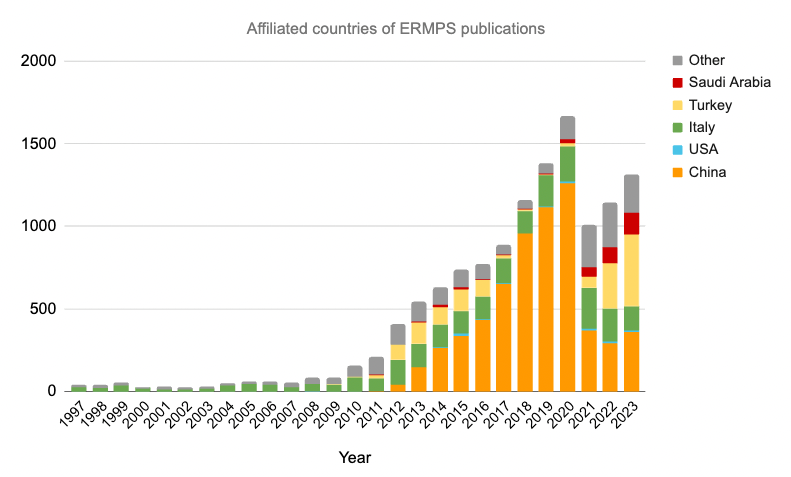
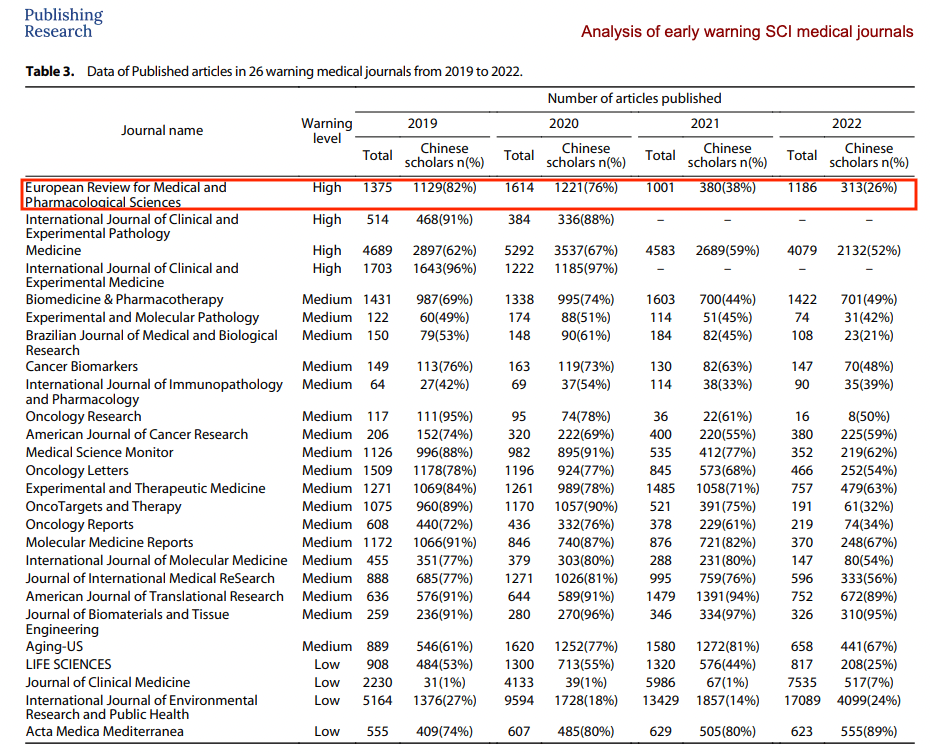
In 2020 the percentage of Chinese papers dropped abruptly, most likely because of ERMPS’s inclusion on an “Early Warning List” released by the National Science Library of the Chinese Academy of Sciences. ERMPS received the highest warning level on that list, mainly because of the high number of retractions from Chinese scholars by that journal.
A Special Issue of ERMPS filled by one author
This December, ERMPS released a special issue, Supplement 6, entitled “Omics sciences in the personalization of diagnosis and therapy” (archived here) containing 16 articles.
The four guest editors wrote a significant chunk of the contents of this special issue: Tommaso Beccari authored 7 of 16 articles, Elisabetta Albi (none), Pietro Chiurazzi (4 of 16), Maria Rachele Ceccarini (4 of 16).
But that is nothing compared to the contributions of one special author. All 16 articles in the December supplement were authored by Matteo Bertelli, MD, PhD. Bertelli is the last author on 14 of the 16 papers, the spot usually reserved for the most senior and supervising researcher.
Bertelli is founder of the Italian MAGI Group and its US version MAGIsnat (see more detail below). Bertelli has a ‘passion for the benefits of the Mediterranean Diet and Lifestyle to bring balance and wellness to individuals and societies’. He does this mainly by selling supplements on Amazon, using many disclaimers to prevent the FDA from complaining about these products.
The supplements contain extracts from olives, such as the polyphenol hydroxytyrosol, and flavonoids from citrus fruits. I guess MAGI here stands for “Making Antioxidants Great Instead”.
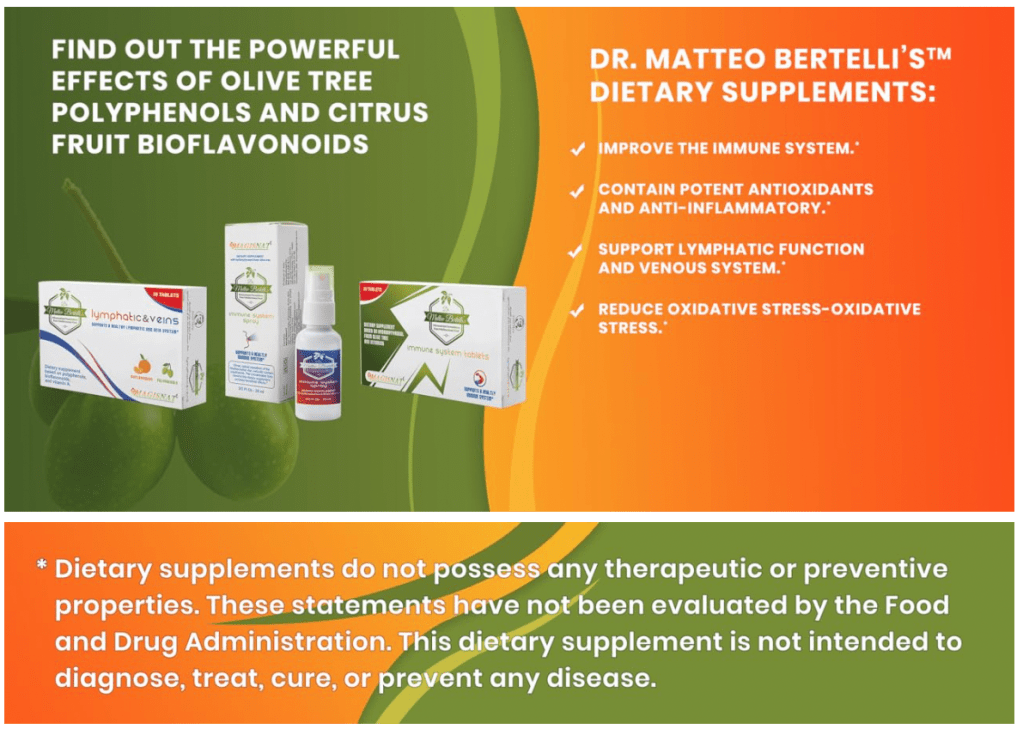
According to the MAGIsnat website, the company is also developing “direct-to-consumer” genomic and metabolomic tests to study diseases such as eating disorders and obesity.
“The authors declare no conflicts of interest”
Knowing about the activities of the MAGI group – selling nutritional supplements and developing OMICS tests to sell to customers, most of the 16 papers in this Special Issue could be interpreted as a conflict of interest for Dr. Bertelli and his MAGI-coauthors. Some examples:
- The potential preventive role of a dietary supplement containing hydroxytyrosol in COVID-19: a multi-center study
- Metabolomic profiling of amino acid alterations in anorexia nervosa: implications for appetite regulation and therapeutic strategies
- Genetic variants identified in novel candidate genes for anorexia nervosa and analysis of molecular pathways for diagnostic applications
- Achievement of sustainable development goals through the Mediterranean diet
- Unraveling the complexity of anti-doping analysis: reassessing meldonium detection and doping verdicts in a case study
- Aldo-keto reductase 1C2 (AKR1C2) as the second gene associated to non-syndromic primary lipedema: investigating activating mutation or overexpression as causative factors
- AKR1C1 and hormone metabolism in lipedema pathogenesis: a computational biology approach
Yet, in all these papers (and in most others in this journal issue), the authors declare no conflicts of interest.
Presence of spike protein in the blood of long-COVID patients
One of the papers in this set of 16 was discussed a lot on social media, in particular among people worried about the safety of the COVID-19 vaccines. In this paper, ‘Presence of viral spike protein and vaccinal spike protein in the blood serum of patients with long-COVID syndrome‘, blood samples from long-COVID patients were tested by the MAGI labs for the presence of variants of the spike protein using mass spectrometry (MS). The paper does not spend many words on patient recruitment or experimental conditions. But apparently, the vaccine version of the spike protein has two amino acid substitutions, which changes its trypsin digestion profile, so that MS can distinguish between the viral and the vaccine versions of the spike protein.
Unfortunately for its value for science, the paper is full of unclarities, discrepancies, errors, and low-quality results.
I wrote a longer critical review on Pubpeer, but here is a summary.
- The inclusion of this paper in a Special Issue completely filled with papers by one and the same author raises serious doubts about the peer review process.
- As with most of the papers in this issue, the authors declare no conflicts of interest, even though they list MAGI labs or MAGIsnat as their affiliation.
- The article lacks details on mass spectrometry methodology or even actual data (other than two values in a table). If you make a big claim, you should come with big evidence – but that is not the case in this paper.
- Out of the 81 long-COVID samples tested, only one patient sample was reported to contain the viral spike protein, while two others had the signature of the vaccine spike protein. The paper does not include a control group, so it is not clear if these might be false positives or aspecific signals.
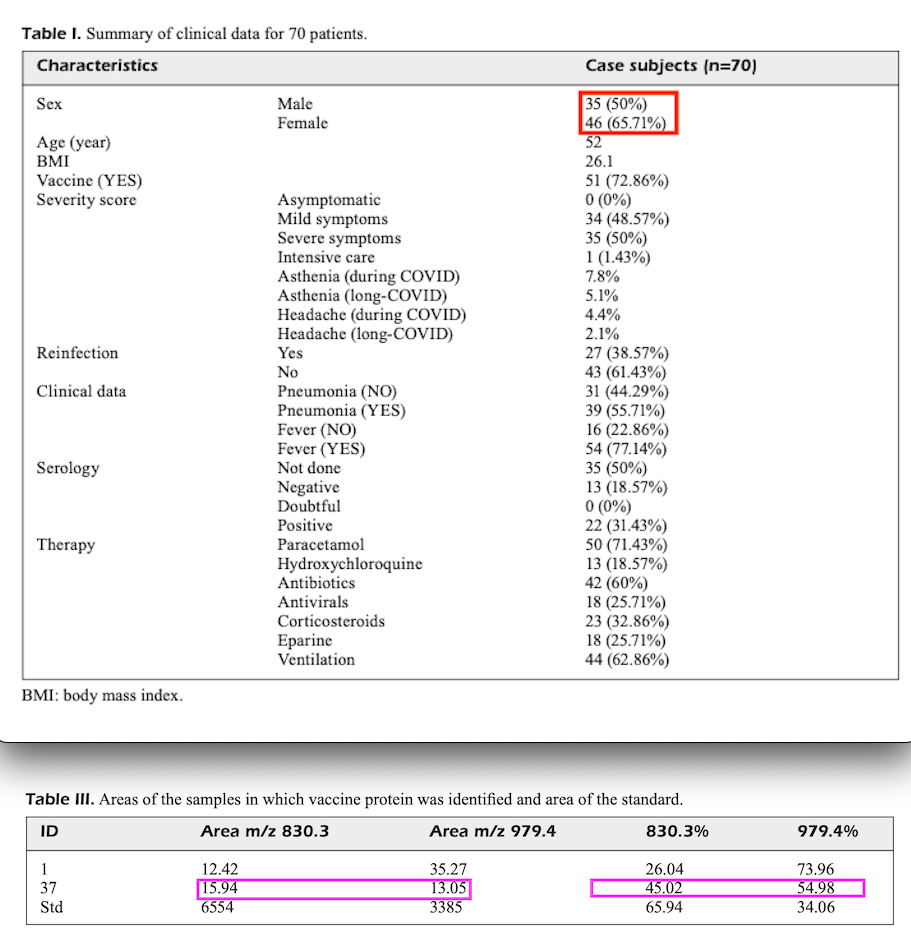
- Potential errors in patient numbers and MS data: The Methods state that 81 patients were recruited, clinical data was only known for 70 of them, and the Discussion mentions 95 patients. There are summation errors in Table I and a potential switch in the mass spec data in Table III.
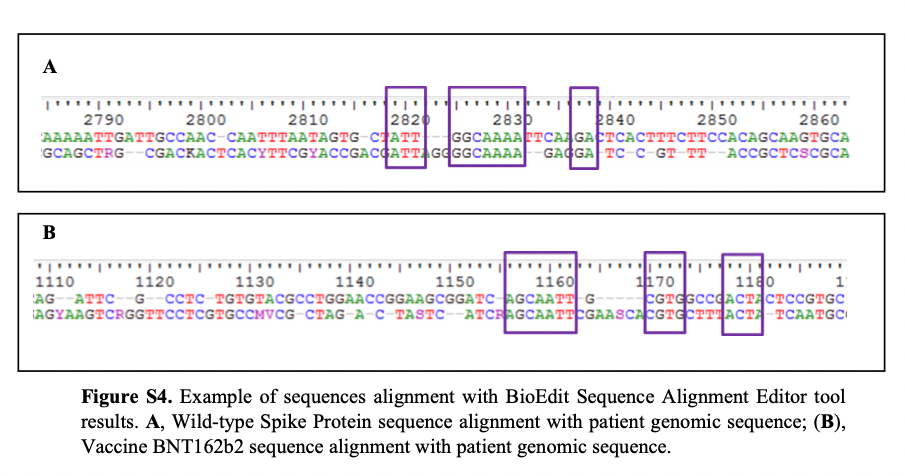
- The paper also includes an elusive ‘viral integration study’, which is only mentioned in the Supplemental, in which patient sera are tested with two (!) rounds of 35 PCR cycles. And in this molecular biology version of “the beatings will continue until morale improves“, half of the samples became positive. The authors mistakenly called this a Nested PCR, and the sequence quality of the provided products was so poor that no conclusions could be drawn. Positive PCRs on DNA extracted from blood samples after 70 cycles definitely do not prove that viral DNA has been integrated into anything other than perhaps the authors’ master mix.
Conclusion
After Chinese scholars were warned not to publish in ERMPS in 2020, it seems that the journal has found a new paying customer-base in authors who love to sell their supplements. The MAGI authors appear to follow the good ole’ strategy of first installing fear (“if you have long COVID you might have a viral gene integrated in your genome”), then providing an analysis tool (“we might be able to detect the spike protein in your blood!”) and a solution (“our olive-based supplements might boost your immune system!”).
ERMPS, being an Open Access journal, charges EUR 1,500 for each published article. Unfortunately, the journal appears to have gone down the slippery slope of accepting pretty much anything that is sent their way, happily raking in the fees and enjoying their inclusion in PubMed, DOAJ, and other indices. Maybe it is time for those organizations to reconsider giving this journal a platform to contribute to the advancement of science.

 Science Integrity Digest
70 PCR cycles 😫 I suppose 40 cycles is enough to amplify one copy, any more is illogical and a direct invitation to generate false positives.
LikeLike
Hi Liz,
Great post, thanks a lot.
But 35 PCR cycles??? Yikes.
Thats sampling/cycling right into the detection limit of that method.
Cheers, Oliver
LikeLike