Today, 25 July 2025, a preprint was posted claiming that significant gene expression changes were found in individuals with new-onset cancer and other diseases after receiving mRNA COVID-19 vaccines, compared to healthy individuals.
A preprint is a non-peer reviewed manuscript – a study or hypothesis that has not yet been evaluated by other scientists. These articles should always be read with caution. Preprints can be brilliant, misguided, or completely bonkers – but they have not been peer-reviewed.
So let’s take a closer look at this preprint.
Update, 12 September 2025: The preprint was withdrawn for “unresolved ethical issues concerning ethical oversight, legitimacy of institutional boards, validity of the study design, and potential biases in study interpretation that compromise the overall trust in the research findings.“
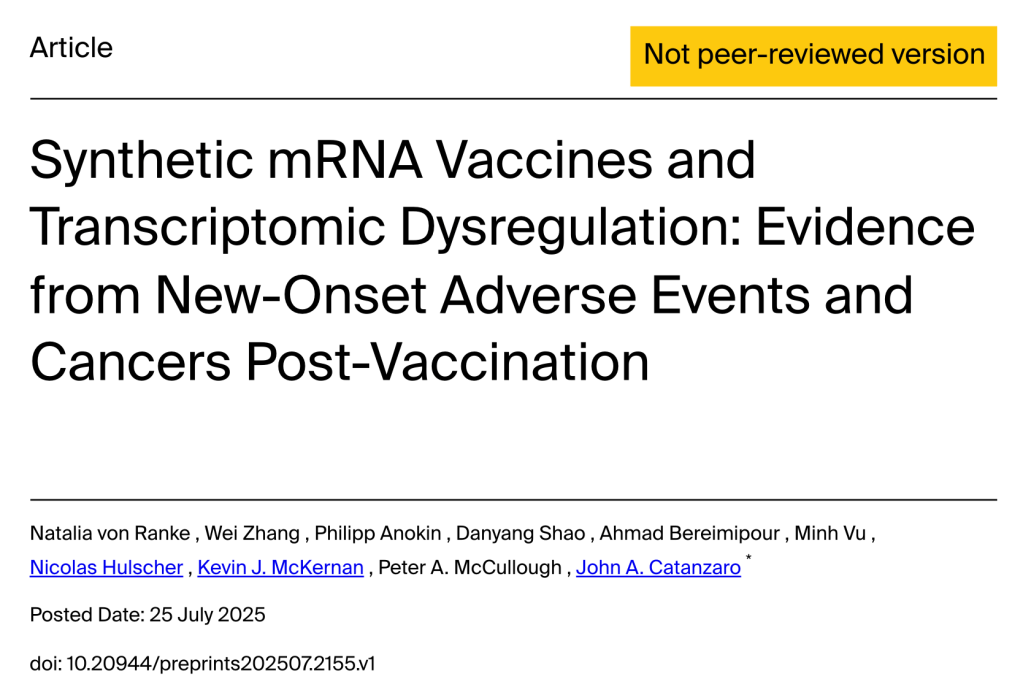
The manuscript compares blood samples from three groups of participants:
- Group 1: 3 individuals who developed new-onset disease symptoms after COVID-19 vaccination
- Group 2: 7 individuals with new-onset cancer diagnoses following vaccination
- Control group: 803 healthy individuals
RNA was extracted from these individuals’ blood samples and sequenced to identify which genes were up- or downregulated between the groups.
Very unequal group sizes
From the groups listed above, it is clear that the particpant numbers were highly imbalanced. With fewer than 10 individuals in the two ‘sick’ groups, it is difficult to draw any meaningful conclusions. In such small groups, a single patient with an unusual RNA expression pattern could significantly skew the results. In contrast, outliers in the much larger control group will have far less influence on the average. This kind of imbalance increases the risk of generating unreliable or non-reproducible findings.
No details about the study’s participants
The preprint provides almost no information about the individuals enrolled in the study. While it describes the RNA extraction and sequencing methods in detail, it offers little to nothing about the participants themselves. In studies like this, researchers are expected to include a “Table 1” — a summary of key demographics and clinical characteristics (such as age, sex, race, BMI, smoking status, or other relevant factors) for each participant group at baseline. This table helps readers assess whether the groups were comparable at the start of the study.
Unfortunately, no such table is provided here. We don’t know the average age of the groups. Were the individuals who developed symptoms or cancer older or younger than the healthy controls? Were they from different geographic regions? Were they otherwise healthy prior to vaccination? None of this is disclosed — a major omission.
The timing of adverse events is also unclear. How long after vaccination did symptoms or cancer appear — days, weeks, or months? The authors do not give any specific details.
Most importantly, there is no information about the vaccination status of the 803 healthy individuals. Were they all vaccinated as well? Without that, the comparison becomes almost meaningless.
Cancer might not be vaccine-related
Diseases such as cardiovascular injury, thrombosis, or cancer can occur at any time. If someone is diagnosed with cancer a few weeks after receiving a vaccine, that doesn’t mean the vaccine caused it – it could simply be a coincidence. To assess whether a vaccine increases cancer risk, a more rigorous study design would compare, for example, 1,000 vaccinated individuals with 1,000 unvaccinated individuals, tracking how many develop cancer over time.
This study did not do that. In fact, we don’t even know how many of the healthy participants in the control group had been vaccinated — a critical piece of missing information.
It’s also important to remember that during the height of the COVID-19 pandemic and lockdowns, many people skipped routine medical check-ups, either due to overwhelmed hospitals or fear of exposure. Clinics were closed, appointments were delayed, and hospitals were full of critically ill patients. For many, it did not feel like the right time to schedule a mammogram or colonoscopy.
As the pandemic eased and vaccinations became widely available, people began returning to doctors for overdue screenings. Not unexpectedly, some of these delayed check-ups led to new diagnoses, including cancer. But that doesn’t mean the vaccines caused the cancer. It just means both events — vaccination and diagnosis — happened around the same time, following a long period of medical disruption.
Unclear ethics permits
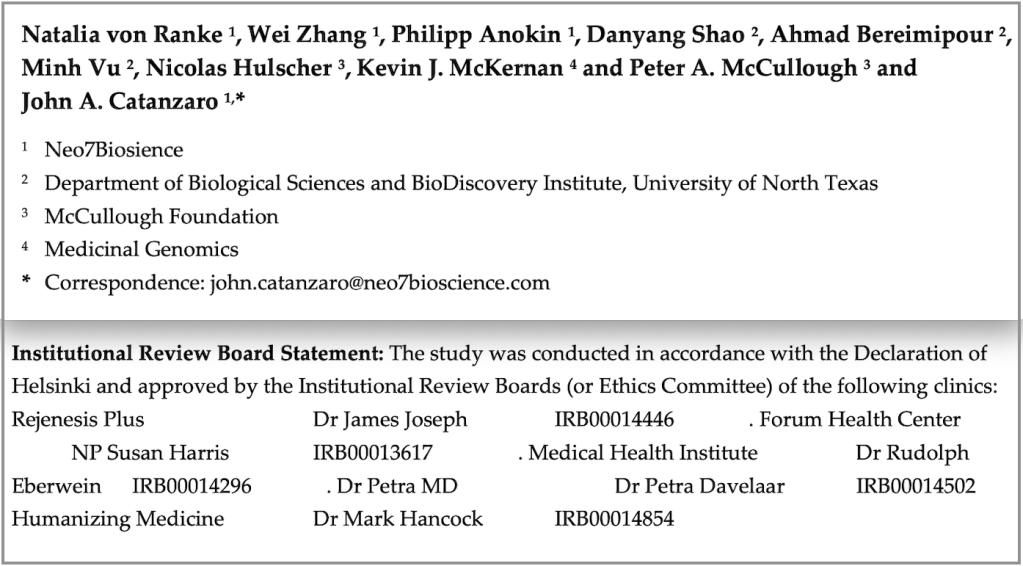
The preprint states that the participating clinics obtained ethical approval through their own institutional review boards (IRBs). However, these clinics appear to be small businesses, often led by a single individual or a very small team. It is unclear whether they actually have formal IRB committees — or whether they are even authorized to recruit participants for human research.
Adding to the confusion, the clinics listed in the ethics section do not match the affiliations of the study’s authors. This raises further questions: Were the individuals involved properly trained to conduct research on human subjects? Were appropriate ethical procedures followed?
Interestingly, the IRB approval numbers provided all follow a very similar format, suggesting they may have come from the same external IRB service — though the preprint does not clarify this.
More details need to be given about the validity and lack of conflict of interest regarding these ethical permits, as well about the qualifications and training of the staff in these clinics to conduct human research.
Potentially biased recruitment
It is also unclear how and where the participants were screened and recruited. Enrolling over 800 healthy individuals and persuading them to donate blood is not an easy task. Where was this done, and how was it organized?
Even more crucially, how were the 10 post-vaccination patients selected? Were they chosen from a larger pool of vaccinated individuals in which most did not experience cancer, thrombosis, or other serious outcomes? If so, how many people were screened, and what were the inclusion criteria?
This is a critical issue that needs to be addressed. Without clear information about recruitment methods, it raises the concern that these cases may have been selectively chosen – a practice known as “cherry-picking” – which can seriously bias the results and undermine the study’s validity.
RNA expression of sick vs healthy people is expected to differ
It is not surprising that the transcriptomic profiles of people with cancer or other illnesses differ from those of healthy individuals. That is exactly what we would expect. And that’s essentially what this preprint found.
But despite how it’s being presented on social media, this is not the bombshell the authors claim it to be. It simply shows that sick people have gene expression patterns consistent with illness. There is no evidence here of a causal link between their disease and the COVID-19 vaccine.
No link between cancer and vaccination is proven
This study is so poorly designed that it demonstrates only one thing: people who are sick have different RNA transcription profiles than people who are healthy.
Duh. That’s a basic and well-known fact.
Because of its deeply flawed design, lack of proper controls, and absence of key participant data, this study offers no evidence – absolutely nothing – that mRNA vaccines cause cancer.
It is especially disappointing that a group of authors with MDs and PhDs attached their names to such a weak and misleading piece of work. One of the lead authors, Peter McCullough, has had his board certifications revoked — and studies like this help explain why.
Frankly, this paper wouldn’t even be acceptable at a high school science fair, let alone meet the standards expected of serious biomedical research.
Update 28 July:
Reese Richardson found a lot more problems in the Catanzaro preprint. He discovered the source of the 803 ‘healthy’ controls (who turned out to be deceased patients), inconsistencies with the sequencing center, and a dash of plagiarism! Read his blog post here: No, mRNA vaccines do not cause “transcriptomic chaos”.

 Science Integrity Digest
Didnt see any mention of the kind of cancers in the paper. Seems like a major flaw.
Looking at mRNA in I presume whole blood cells, which include immune cells (not mentioned in paper, my guess). Immune cells activated due to cancer have very much different transcription profiles than unactivated immune cells of healthy adults….that would be expected.
“MYC activation were prominent in both groups, while immune signaling via TLRs and type I interferons was particularly elevated in cancer patients” yes would be expected in activated immune cells from cancer patients, independent of vaccination.
LikeLike
Subject: Re: Commentary on Preprint: COVID-19 mRNA Vaccines and Transcriptomic Dysregulation
Dear Science Integrity Digest editorial team,
Thank you for your recent critique of our preprint, “Synthetic mRNA Vaccines and Transcriptomic Dysregulation: Evidence from New-Onset Adverse Events and Cancers Post-Vaccination.” We value the opportunity to clarify several key points you raised.
Although this work is a preprint, it is based on high-quality, reproducible transcriptomic analysis conducted under ethical review. The paper’s goal is mechanistic hypothesis generation, not causal or epidemiologic proof. Scientific inquiry in the post-COVID era demands early and transparent reporting of outlier patterns, particularly when those patterns converge on biologically coherent pathways.
This concern overlooks a critical clarification:
In contrast:
This comparison is not a case–control trial. It is a high-fidelity, small-n mechanistic contrast between rare pathologic molecular signatures and established healthy transcriptomic baselines.
All 10 patient samples were collected under active clinical supervision and within the scope of private, registered Institutional Review Boards (IRBs) associated with independent precision-medicine clinics.
The 803 control datasets required no IRB oversight, as they are open-access, de-identified transcriptomic datasets previously generated and peer-reviewed in unrelated healthy cohort studies.
We agree this study is exploratory. Follow-up experiments (e.g., qPCR, cytokine assays, proteomics) are already in progress. The transcriptomic findings align with external literature reporting:
This coherence supports our interpretation, though further work is ongoing.
All tables and figures clearly define and separate Normalized Enrichment Scores (NES) from False Discovery Rates (FDR). If any phrasing in the narrative suggested equivalence, this will be revised for clarity.
Final Remarks
We appreciate your engagement and share your desire to uphold high standards of evidence. This study does not make unwarranted claims—it provides a snapshot of convergent molecular disruption in clinically relevant, post-vaccine pathologies. It calls for replication, not alarmism.
We remain open to sharing data, discussing methodology, and collaborating with others to strengthen the scientific dialogue.
Sincerely,
John A. Catanzaro, PhD
Principal Investigator, Neo7Bioscience
[john.catanzaro@neo7bioscience.com]
LikeLike
Thank you, Dr. Catanzaro for your quick reply, which is much appreciated.
The details you give in your reply are very helpful, but one might wonder why they were not included in the preprint? These are basic descriptions of the participants that should have been included in the Methods.
Some quick thoughts:
* There is no mention about the source of the publicly available dataset of the 803 healthy controls – giving credit is an important courtesy in science.
* Using an older dataset as a reference raises questions about comparing data generated with potentially different technologies. How confident are you that you can compare RNA-seq data generated in one lab to data generated years ago in (presumably) another lab?
* Cancer/adverse events happening 1 year after the vaccination is a hugely long timeline. It is completely expected that of the millions of folks who have been vaccinated with COVID-19 mRNA vaccines, some would have developed cancer in that year. That would just happen by chance, and does not infer causality at all. Some of those patients might have contacted one of the clinics affiliated with this study. But that is not a random selection. You did not include any person who developed cancer but was not vaccinated, nor any person who remained healthy after vaccination. These 10 patients still appear to be hand-picked for this study.
* You write “We do not assert causality” – but yet, your co-author Nicolas Hulscher, wrote on Twitter “BREAKING STUDY: mRNA Injections Induce Severe, Long-Lasting Genetic Disruption Linked to Cancer and Chronic Disease” and “we discovered that COVID-19 “vaccines” SEVERELY disrupt expression of THOUSANDS of genes” (https://x.com/NicHulscher/status/1948702420894122083). So yes, at least one of you did assert causality. Also, Figure 4 in this preprint suggests causality: there is a big arrow from the mRNA vaccination cartoon to the Differential Gene Expression plots.
* Not sure what bullet points 6-8 refer to. My critique of the preprint focused on the choice of patients, hugely uneven group sized, and interpretations with respect to vaccine causality.
Sincerely,
Elisabeth Bik, PhD
LikeLiked by 1 person
The IRB numbers are for registrations with the US NIH Office for Human Research Protections, you can look them up here:
https://ohrp.cit.nih.gov/search/irbsearch.aspx?styp=bsc
The “independent precision-medicine clinics” are “integrative”, “holistic”, “naturopathic”, etc, and all seem to rather small practices that I would not expect to have a very active IRB. From Dr. Catanzaro’s response it would appear that these were patients who had their genes sequenced as part of their treatment.
LikeLiked by 1 person
Guess I’d better not exercise, alter my diet, take a vitamin, or change my sleep patterns…the resulting before/after volcano plots would likely show massive transcriptomic “dysregulation”.
LikeLike