Is science self-correcting? Not in this Elsevier journal.

Around 2014-2015, I screened 20,000 biomedical articles for image duplication in 2014-2015. About 4% of those papers, 782 to be exact, contained inappropriate duplications. Together with my coauthors Arturo Casadevall and Ferric Fang, I published that work in mBio in 2016 here.

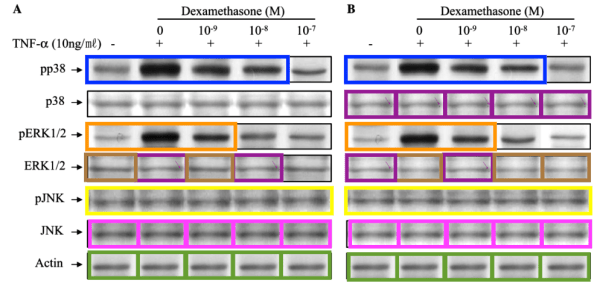
Unfortunately, many of these problematic papers are still not addressed by the journals now, ten years later, even though the concerns in some of them are far beyond what could be blamed on an innocent error. Two of those examples were published in Cytokine, a journal that seems to care little about the problematic papers they published in the past.
Continue reading “Is science self-correcting? Not in this Elsevier journal.”

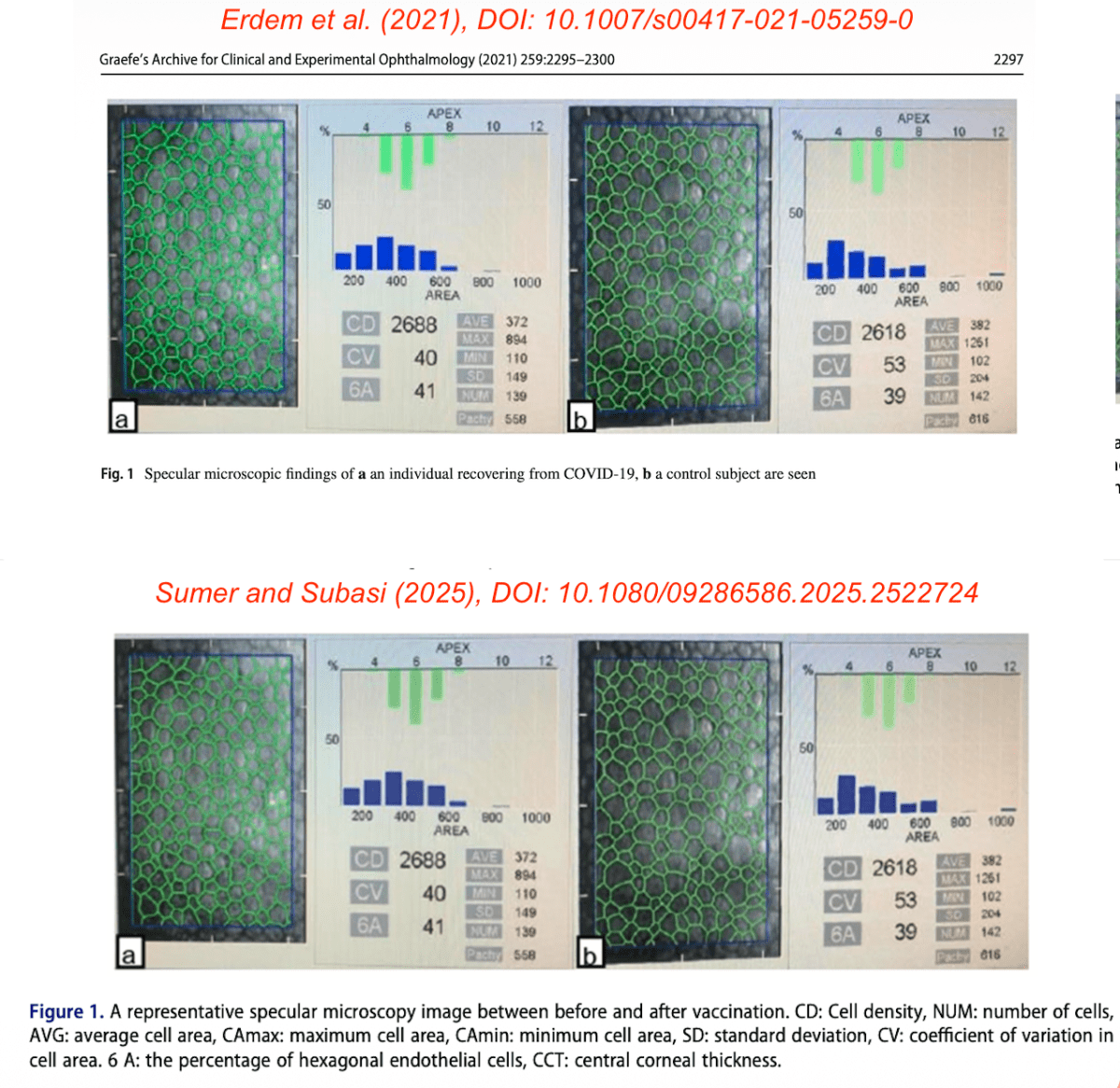
COVID-19-vaccine-induced eye damage? Reused images, impossible demographics, and an incomplete ethics approval number

A 2025 paper published in Ophthalmic Epidemiology is being promoted online as proof that COVID-19 vaccines damage the eyes. Before accepting that conclusion, it was worth looking at the paper itself.

A closer look at the article revealed a reused figure published by another group of authors, 59 men plus 69 women in a study of 64 participants, no control group, and an ethics approval number that seems generic and incomplete.

Continue reading “COVID-19-vaccine-induced eye damage? Reused images, impossible demographics, and an incomplete ethics approval number”

Reporting from the 2026 World Conference on Research Integrity

Early May, I attended the 2026 World Conference on Research Integrity (WCRI) in Vancouver, BC, Canada. This conference is held every two years. In 2024, I went to the WCRI in Athens, Greece, and in 2022 to the one in Cape Town, South Africa. In this post, I will provide a short summary and links to my BlueSky #WCRI2026 posts for all the sessions I attended.

WCRI logo, taken from https://wcri2026.org/
Continue reading “Reporting from the 2026 World Conference on Research Integrity”

The Camel’s Camel

On some days, after hours of image scanning, I feel like doing something different. Today, I searched for some scientific papers containing “tortured phrases”. This term was first coined by Guillaume Cabanac et al. in a 2021 preprint.

Tortured phrases are bizarrely synonymized versions of standard scientific terms produced when authors run copied text through paraphrasing or translation software to disguise plagiarism. This can lead to funny sounding word combinations, such as “bosom malignancy” instead of “breast cancer“.

Today, I found a beautiful example of synonymized plagiarism involving the microbiome of a camel’s udder.

A camel’s camel – image drawn by ChatGPT
Continue reading “The Camel’s Camel”

UnEDXpected Peaks

Over the past couple of days, I have been reviewing a series of Materials Science papers, all co-authored by the same group of researchers from the Universities of Lahore, Chakwal, and Sargodha in Pakistan. While reviewing them, one analytical technique kept standing out for unusual reasons.

Continue reading “UnEDXpected Peaks”

Peer Review Congress Chicago – Day 3

Good morning from Chicago! We will start Day 3 (last day) of the 10th International Congress on Peer Review and Scientific Publication. @peerreviewcongress.bsky.social / peerreviewcongress.org/peer-review-… #PRC10 <— This hashtag will give you all the posts! You can also click on this feed, created by @retropz.bsky.social: bsky.app/profile/did:…

[Day 1] and [Day 2].

Continue reading “Peer Review Congress Chicago – Day 3”

Discontinuous ridiculous stools – a preprint full of tortured phrases and stolen data

Patients with provocative entrail illness unclassified gave to crisis division a 3-day history of sickness, retching, migraine and irregular stomach torment alongside discontinuous ridiculous stools as of late.

If you cannot wrap your brain around this sentence, don’t worry. Neither can I.

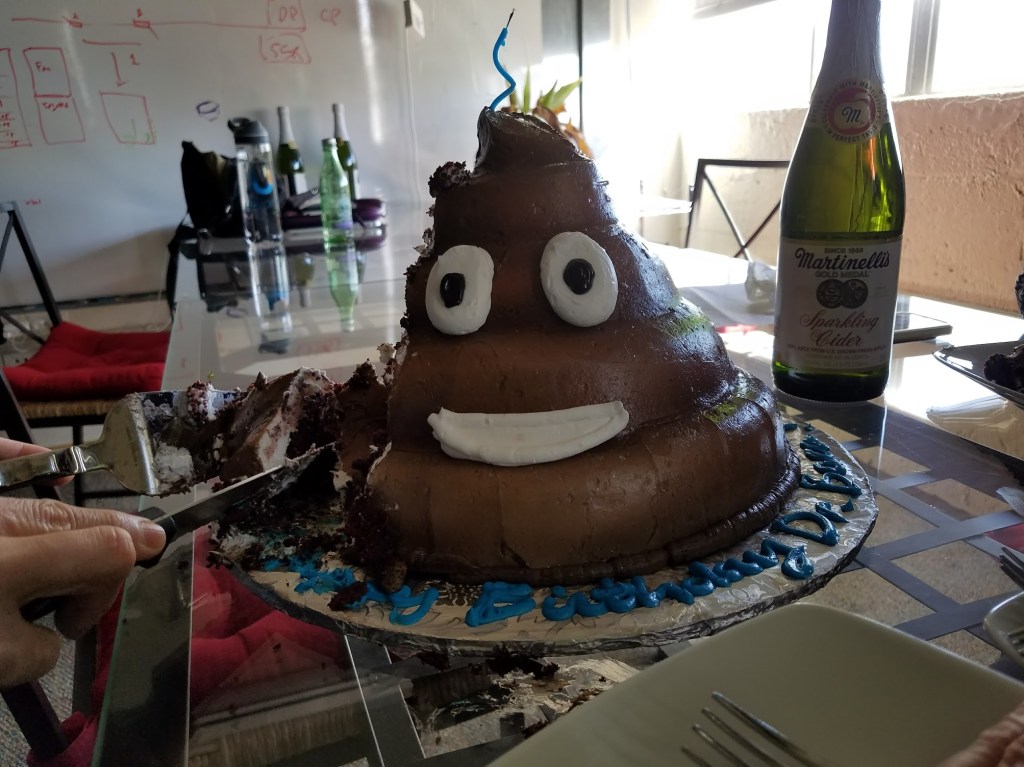
A photo of a very ridiculous stool: a poop-emoji cake, with big white googly eyes and twisted candles on top. Taken at uBiome headquarters, March 2017.
Continue reading “Discontinuous ridiculous stools – a preprint full of tortured phrases and stolen data”

Preprint claiming that COVID-19 mRNA vaccines cause transcriptomic dysregulation is deeply flawed

Today, 25 July 2025, a preprint was posted claiming that significant gene expression changes were found in individuals with new-onset cancer and other diseases after receiving mRNA COVID-19 vaccines, compared to healthy individuals.

A preprint is a non-peer reviewed manuscript – a study or hypothesis that has not yet been evaluated by other scientists. These articles should always be read with caution. Preprints can be brilliant, misguided, or completely bonkers – but they have not been peer-reviewed.

So let’s take a closer look at this preprint.

Update, 12 September 2025: The preprint was withdrawn for “unresolved ethical issues concerning ethical oversight, legitimacy of institutional boards, validity of the study design, and potential biases in study interpretation that compromise the overall trust in the research findings.

Continue reading “Preprint claiming that COVID-19 mRNA vaccines cause transcriptomic dysregulation is deeply flawed”

Science Integrity Digest Summer 2025

It is hard to find the time to post here. I’m getting lots of requests to help scanning papers for image problems, and am also traveling a lot to give talks and be in panels. So my ‘monthly’ digests have now turned into quarterly digests, hahaha.

These past months, I have traveled to Berlin to receive the Einstein Foundation Award, to Oxford for the FAIRS Meeting, participated in a workshop in Stockholm organized by the Royal Swedish Academy of Sciences about the Reformation of Science Publishing, a conference in London at the Royal Society about the Future of Science Publishing, and a gathering with other science detectives and journalists in Krakow, Poland. In between, I gave several talks at research institutions and medical schools. I am getting pretty good at packing suitcases!

Here is a round-up of some noteworthy articles about research integrity.

Continue reading “Science Integrity Digest Summer 2025”

ScienceGuardians, where disgruntled authors complain about PubPeer

On Twitter/X, @SciGuardians, associated with the website ScienceGuardians.com, is promising to ‘uncover’ some big conspiracy of fraudulent @pubpeer.com users.

But in reality, the account appears to be run by one or more disgruntled scientists with dozens of problematic papers. And there is no big reveal.

Continue reading “ScienceGuardians, where disgruntled authors complain about PubPeer”