Hindawi — and its parent company, Wiley — have recently announced that they will retract hundreds of papers from journals targeted by paper mills. The papers were all published in ‘special issues’, with the guest editors being either asleep at the wheel or perhaps knowingly looking the other way.
In this blog post, I will take an in-depth look at some of these papers.

Mass retractions by Hindawi
As reported by Retraction Watch in April 2023, Hindawi will be retracting 1,200 papers, published in the same journals as those retracted in an earlier batch of over 500 papers announced in September of last year.
A simple search on the Hindawi website shows that the number of retractions might even be much higher. Hindawi retracted its first paper in 2009. From 2009 to 2019, Hindawi retracted an average of 26 papers per year. But in 2022, the publisher published 351 retractions, and in 2023 that number skyrocketed to 3,936 – and it’s only August!

The Hindawi journals most affected by these 2023 retractions (as of August 2023) are:
- BioMed Research International [142 papers retracted]
- Computational and Mathematical Methods in Medicine [423]
- Computational Intelligence and Neuroscience [585]
- Contrast Media & Molecular Imaging [138]
- Disease Markers [120]
- Evidence-Based Complementary and Alternative Medicine [459]
- Journal of Environmental and Public Health [216]
- Journal of Healthcare Engineering [396]
- Journal of Nanomaterials [42]
- Mathematical Problems in Engineering [210]
- Mobile Information Systems [190]
- Oxidative Medicine and Cellular Longevity [45]
- Scanning [46]
- Scientific Programming [84]
- Security and Communication Networks [241]
- Wireless Communications and Mobile Computing [437]
All the retracted papers I checked were accompanied by the same general Retraction Notice:
“This article has been retracted by Hindawi following an investigation undertaken by the publisher [1]. This investigation has uncovered evidence of one or more of the following indicators of systematic manipulation of the publication process:
- Discrepancies in scope
- Discrepancies in the description of the research reported
- Discrepancies between the availability of data and the research described
- Inappropriate citations
- Incoherent, meaningless and/or irrelevant content included in the article
- Peer-review manipulation
The presence of these indicators undermines our confidence in the integrity of the article’s content and we cannot, therefore, vouch for its reliability. Please note that this notice is intended solely to alert readers that the content of this article is unreliable. We have not investigated whether authors were aware of or involved in the systematic manipulation of the publication process.
Wiley and Hindawi regrets that the usual quality checks did not identify these issues before publication and have since put additional measures in place to safeguard research integrity.
We wish to credit our own Research Integrity and Research Publishing teams and anonymous and named external researchers and research integrity experts for contributing to this investigation.
The corresponding author, as the representative of all authors, has been given the opportunity to register their agreement or disagreement to this retraction. We have kept a record of any response received.”
Retraction Notice , https://www.hindawi.com/journals/dm/2023/9815623/ and thousands of other retractions.
Special Issues
With some exceptions, all of these retractions are from papers published in “Special Issues”. Special issues are additions to the regular papers published by journals. They are not managed by the regular editors of these journals but by guest editors, who might be inexperienced and naive, but eager to pad their resume and fill up the issues with insignificant contributions from friends, paper mills, and AI chatbots. Others have written posts about these special issues, so I will refer to this preprint by Dorothy Bishop, and these posts by Nick Wise at BishopBlog, Christos Petrou at the Scholarly Kitchen, and PubPeer pseudonym Parashorea tomentella at ForBetterScience.
A quick survey of some of the retracted papers reveals serious problems, which could have been caught during peer review. Let’s take a closer look at some of these papers. Would you have spotted the problems pointed out below?
Discrepancies in scope
Some of the retracted papers were published in journals and special issues that appear to be very much out of scope.
The Journal of Nanomaterials retracted several papers that did not seem to be about nanomaterials, as judged by a simple textual search for “nano” which yielded 0 results in those papers. “Application of TOPSIS Method Combined with Grey Relational Degree in the Selection of Snow-Melting Agent Use Plan” and “The Mathematical Analysis of the New Fractional Order Ebola Model”
“The Value of MRI Combined with AFP, AFP-L3, GP73, and DCP in the Diagnosis of Early Primary Liver Cancer” was published in Disease Markers’ special issue “Biomarkers and Therapeutic Markers Based on Novel Epigenetic Regulation in Diseases”, but the term “epigen*” was not found in the text nor the citations.
Evidence-Based Complementary and Alternative Medicine retracted the 2022 paper by Liu et al. entitled “The Application of Nurse Stratified Management in Nursing Management”. There appears to be little relation to the topic of the journal or that of the special issue “Nutraceuticals, Functional Foods, and Dietary Supplements as a Natural Immunomodulator”. The paper itself refers to nursing quality and happiness using poorly defined self-made scales, and includes the puzzling statement that no data were used to support this study.

As a side note, the search term “No data were used to support this study” returns over 8,000 results in Google Scholar, many of which are on the Hindawi.com site. I suppose one must be grateful that no data was harmed to create these fake papers! Many of the papers deserve scrutiny, so if you have some free time, please help by writing critical reviews on PubPeer.

Discrepancies in the description of the research reported
The Methods section of the now-retracted paper “miR-211-5p Alleviates the Myocardial Ischemia Injury Induced by Ischemic Reperfusion Treatment via Targeting FBXW7” (accepted within a month) describes experiments on AC16 heart cells. Yet the Results section shows data obtained on healthy subjects and patients. There is no description of where and how patients were recruited or if IRB approval was obtained.

The paper was also published in the seemingly unrelated special issue “Minimally Invasive Treatment Protocols in Clinical Dentistry”, and there are some issues with the TUNEL assay as well.
X marks the spot
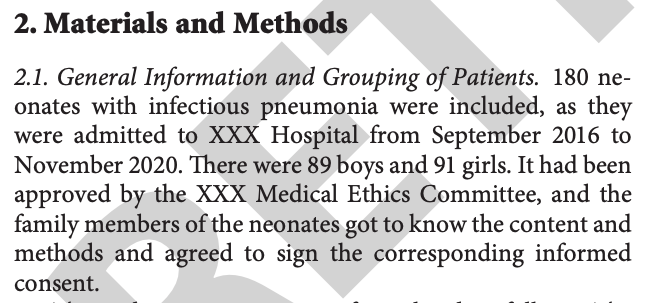
The paper “Common Pathogens and Drug Resistance of Neonatal Pneumonia with New Multichannel Sensor”, published by Dong et al. in Contrast Media and Molecular Imaging contains the statement “180 neonates with infectious pneumonia were included, as they were admitted to XXX Hospital from September 2016 to November 2020. There were 89 boys and 91 girls. It had been approved by the XXX Medical Ethics Committee”. The term “XXX” could suggest this is a fake paper, written by a paper mill ghost writer and sold to the highest bidder – without replacing “XXX” with the appropriate hospital name. Alternatively, this might be an anonymized version of the text that had been sent out to peer reviewers. One would have hoped, though, that the actual hospital would have been added to the final version.
In a similar vaguely worded manner, “The Value of MRI Combined with AFP, AFP-L3, GP73, and DCP in the Diagnosis of Early Primary Liver Cancer” lists authors with three different affiliations, but the paper does not clarify where ethical approval was obtained or from which hospital the patients were recruited.

Acne of the leg
For an upcoming webinar, I took a closer look at the now-retracted “Effects of CT Combined with Modified Qinfan Decoction on Improving Sores”, published in the special issue “Macro Molecular Imaging in Radio Biology” of the Hindawi journal Contrast Media & Molecular Imaging.
The entire article makes little sense.
The medical condition described in the article changes from “sores” (Title) to “LVU” (Introduction, not defined), before it decides on “acne”. The treatment switches from a Chinese Traditional Medicine mixture to a negative pressure sealing drainage (VSD). The last sentence of the Abstract concludes that “Qinfan decoction combined with negative pressure sealing drainage technology has a significant effect on the treatment of severe acne and can promote its rehabilitation”. Despite this conclusion, the terms “acne” and “vacuum” or “negative pressure” are not mentioned in the title. And despite the title and a Methods paragraph about CT Technology — presumably referring to computed x-ray tomography — this technique was not used to treat or analyze the acne patients. In any case, its use would also make no sense, since acne severity is easily monitored by the unaided eye, with no need for any special imaging technique.
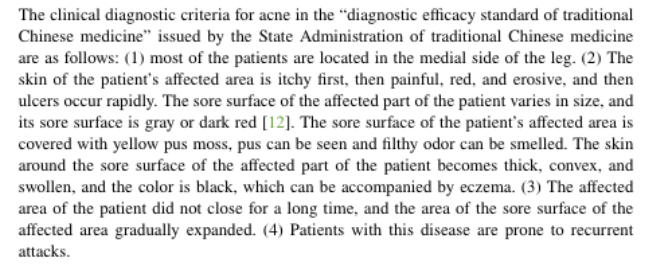
The description of the acne patients and their lesions doesn’t make much sense either. First, the patients in this study were 40-79 years old, which seems a bit older than the average acne patient, and second, the description of the acne lesions as necrotic and black also seems a bit more dramatic than most acne cases.
Did the authors mean to write about bed sores?
There are several referrals to treatment of the leg – not a body part where acne usually manifests itself:
- “The clinical diagnostic criteria for acne in the “diagnostic efficacy standard of traditional Chinese medicine” issued by the State Administration of traditional Chinese medicine are as follows: (1) most of the patients are located in the medial side of the leg”.
- “After cleaning the sore surface of the affected area for the patient, immerse the leg in the liquid medicine for about 10 ∼ 15 min, cover the sore surface with sterile gauze, and let it soak 3–5 times a day.”
- “Acne refers to a chronic ulcer that occurs between the skin on both sides of the lower 1/3 tibial ridge of the patient’s lower leg.”
The references also make little sense.
- “Consulting a large number of relevant theories and references, it is found that there are more and more relevant studies on the treatment of acne. The commonly used methods of Western medicine include intravenous infusion of anti-inflammatory and intravenous active drugs, debridement and dressing change of the affected area, and surgical treatment for the cause, but due to internal venous hypertension and congestion, it is difficult to heal, and it is easy to relapse after healing [1].” Reference 1 is about measuring skull-base tumor volume.
- “This deficiency is marked by excess, and this deficiency is the deficiency of the liver and kidney. The marked excess can also be divided into the evil of clearing dryness and dampness [5].” Reference 5 is about “Differential evolution algorithm with strategy adaptation for global numerical optimization”.
- “4.2. Recovery of Patients in the Two Groups after Treatment. After receiving treatment, the time for the improvement of clinical symptoms, the time for the growth of new granulation, and the time for the reduction of the sore surface area by 1/2 in the treatment group were shorter than those in the control group, and the healing rate of the sore surface was higher than that in the control group (P < 0.05) [22], see Table 4 for details [23].” Reference 23 is about foam rolling and stretching.
- “There was no significant difference in blood pressure, electrocardiogram, chest X-ray, routine blood and urine, and liver and kidney function before and after treatment, and it was within the controllable range [24].” Reference 24 is about range of motion and pain in the ankle.
The affiliations of two of the three authors also seem very much out of place. What do a researcher in the Geriatric Department and a researcher in the National Engineering Laboratory for AIDS Vaccine have in common? A study about acne treatment would not have been my top guess. And according to PubPeer user Parashorea tomentella, the ‘stu.wxic.edu.cn’ email domain of the corresponding author belongs to the Wuxi Vocational Institute of Commerce, not to Jiling University.
And last but not least, the paper includes no wording about IRB approval or patient consent — something that should have been checked for during the editorial approval process. But based on the problems mentioned above, this whole paper does not appear to have been critically reviewed at all.
Peer-review manipulation
As the retraction notice mentions, the peer review process for these now-retracted papers might have been compromised. Without knowing who the peer-reviewers of this paper were, it is hard to know what went wrong. Perhaps the authors suggested some friends as peer reviewers, or perhaps the guest editor of the special issue was too eager to fill it with content.
Either way, by checking some of these retracted papers, each appears to have many issues, and the retractions seem to be solid. Clearly, the Guest Editors have not been paying attention.
If you have some spare time, I hope you can help by flagging more of these papers published in Hindawi’s Special Issues. There must be thousands more that are worthy of a retraction.

 Science Integrity Digest
Thanks for your perseverance.
LikeLike
Dear Elisabeth, I am unsurprised by your latest disclosure. Several years ago I expressed concern about a Special Issue to Elsevier viz: “[the]… Guest Editor of the … Special Issue, while also author or first co-author in seven of the twelve articles … in my view hardly an arm’s length position for a peer-reviewed journal editor.” I noted Elsevier set maxima for Guest Editors as authors in some Special Issues, but this guideline was not applied. After working through the Special Issue editor to the Elsevier manager for the journal and finally to the internal Elsevier team set up for this purpose … no admission was made: no action taken. It was deemed acceptable practice. IMHO some papers in that Special Issue were not properly peer-reviewed.
Elisabeth, the question is … how consistent is it to criticise so-called paper mills, when mainstream publishers set such an example?
LikeLike
Dear Elisabeth,
Thank you very much for sending this link and single-handedly takin on this massive scientific misconduct.
I have been following your mountainous efforts and contribution in this regard. I have been trying to also dog out spurious structures (scientific frauds in 3D) and also submitted it on PubPeer. As the atomic coordinates of such mysterious structures, defying the natural protein folding rules of nature, are in the it has become extremely difficult to even build the atomic models based on true native structures as all the algorithms use the dictionaries of these submitted folds and structures.
Please find the link below: https://pubpeer.com/publications/075F47FA3FC75072C212B2E3B79515#
There are several others that I have identified as well and not sure how to get them off as the administratives of protein databank (PDB) and (EMDB) are least bothered to even reply.
Best, Pradeep
LikeLike
https://zenodo.org/record/8198177
Pinocchio paradox in scientific publications, Yours truly, I or we are lying
Unfortunate , Pinocchio paradox still continues in the future tense.
LikeLiked by 1 person
I’m not a scientist (though I did get a degree in science before changing my career plans). I’m a historian of the ancient and mediaeval Near East. Let me tell you there are attempts to start this mechanism in my field. A clique of authors will present papers at conferences with very few people present, either belonging to the clique or ignorant of the specific subject of the paper. These papers will be presentations of common knowledge. They will then be printed in the proceedings, disguised as research by putting in footnotes to their own previous presentations of common knowledge, or such presentations by other members of the clique. Because computers show that these persons have published a lot with the right keywords in the title or description, and they have been mentiooned by the other members of the clique, they will be invited to write a chapter in a volume supposedly setting out new developments in the field. They then produce a rearrangement of one of their previous papers, often with a bit more of what is common knowledge to throw computer searches off. Then each of them will be invited to do this for another collective volume aimed at a slightly different readership, and they can refer to their own publications of common knowledge or those of their associates. Data will be made up in some articles that are partly original, and then other members of the clique will quote the data and conclusions as proven. When publishers look for peer reviewers, their computer will pick up numerous publications by these persons with the right keyword. If the article or book being looked at shows that data commonly cited have no evidence, the peer reviewer will cite numerous works by his associates or perhaps just their names while saying that there is a “scholarly consensus” contradicting the article or book being looked at, and that the author of the article or book has invented data, or has misunderstood data, or both. The publisher will believe this because the reviwer has published a lot with the right keywords. The publisher won’t know that much of this is the same material rearranged and renamed, and won’t realise that the two main reasons why the content of these publications is largely undisputed is that they will be cited as fact by other members of the clique, and also that most of the content of these publications will be common knowledge. It might be thought that historical documentation would be hard to manage, but there are ways of doing it. One of the simplest is to let readers and publishers believe that if you hold a Chair, you must be omnniscient. Another is to write on a subject not widely known. Another is for a member of the clique to write a book for academics not specialising in the field, presenting it as a survey of the present state of knowledge of the field. That way a lot can be put in, not easily noticed because sitting next to statements of common knowledge. The names of scholars not members of the clique or inconvenient to them will be left out, so that most readers won’t know of their publications.
Contrary to what this site’s computer has done, my name is Ruairidh Boid. You can verify that I’m real by looking at the Academia website.
LikeLike
Another 500 retractions from Hindawi released on 9/27/2023 from across their journals including from the shuttered journals, Computational and Mathematical Methods in Medicine and the Journal of Healthcare Engineering, but also, Oxidative Medicine and Cellular Longevity, etc.
Nice to see that many of these retracted papers have PubPeer comments linked to them. The system is working!
LikeLike
Dr. Joseph Loscalzo’s papers have no ethical problems. Do not maliciously raise fake allegations.
LikeLike
Bit of a non-sequitur, innit?
LikeLike