Is science self-correcting? Not in this Elsevier journal.

Around 2014-2015, I screened 20,000 biomedical articles for image duplication in 2014-2015. About 4% of those papers, 782 to be exact, contained inappropriate duplications. Together with my coauthors Arturo Casadevall and Ferric Fang, I published that work in mBio in 2016 here.

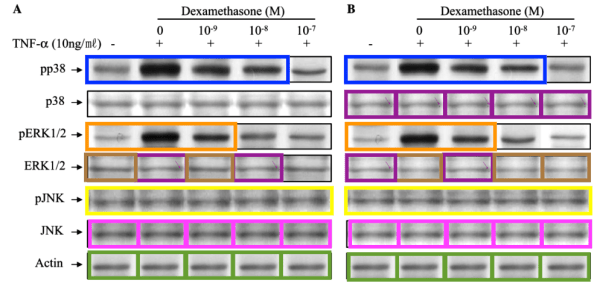
Unfortunately, many of these problematic papers are still not addressed by the journals now, ten years later, even though the concerns in some of them are far beyond what could be blamed on an innocent error. Two of those examples were published in Cytokine, a journal that seems to care little about the problematic papers they published in the past.
Continue reading “Is science self-correcting? Not in this Elsevier journal.”

The Camel’s Camel

On some days, after hours of image scanning, I feel like doing something different. Today, I searched for some scientific papers containing “tortured phrases”. This term was first coined by Guillaume Cabanac et al. in a 2021 preprint.

Tortured phrases are bizarrely synonymized versions of standard scientific terms produced when authors run copied text through paraphrasing or translation software to disguise plagiarism. This can lead to funny sounding word combinations, such as “bosom malignancy” instead of “breast cancer“.

Today, I found a beautiful example of synonymized plagiarism involving the microbiome of a camel’s udder.

A camel’s camel – image drawn by ChatGPT
Continue reading “The Camel’s Camel”

The rat with the big balls and the enormous penis – how Frontiers published a paper with botched AI-generated images

A review article with some obviously fake and non-scientific illustrations created by Artificial Intelligence (AI) was the talk on X (Twitter) today.

The figures in the paper were generated by the AI tool Midjourney, which generated some pretty, but nonsensical, illustrations with unreadable text.

It appears that neither the editor nor the two peer reviewers looked at the figures at all. The paper was peer-reviewed within a couple of weeks and published two days ago.

Dear readers, today I present you: the rat with the enormous family jewels and the diƨlocttal stem ells.

Tweet by Dr. Houldcroft discussing Figure 1 from the paper. Source: https://twitter.com/DrCJ_Houldcroft/status/1758111493181108363
Continue reading “The rat with the big balls and the enormous penis – how Frontiers published a paper with botched AI-generated images”

Hindawi’s mass retraction of “Special Issues” papers

Hindawi — and its parent company, Wiley — have recently announced that they will retract hundreds of papers from journals targeted by paper mills. The papers were all published in ‘special issues’, with the guest editors being either asleep at the wheel or perhaps knowingly looking the other way.

In this blog post, I will take an in-depth look at some of these papers.

Continue reading “Hindawi’s mass retraction of “Special Issues” papers”

The Hot-Crazy Matrix paper

Lots of buzz yesterday on Twitter about a paper already published online a year ago, but assigned to the February 2021 issue of Personality and Individual Differences, an Elsevier/Science Direct journal. The paper builds upon a popular — but not scientific — YouTube video in which men are advised to only date women who are “hot and not too crazy”, and women are believed to only want to marry rich guys.

Figures 1 and 2 of the paper — taken from this video but without giving credit — are presented in this paper as scientific data. Of course, I have concerns.

Continue reading “The Hot-Crazy Matrix paper”

Journal accepts fake story about scooters and hydroxychloroquine

The Asian Journal of Medicine and Health might be one of those journals that will accept anything sent their way, as long as the authors pay the publication fee.

Yesterday, it published an obviously fake study that claimed that hydroxychloroquine could prevent push-scooter accidents – but only in Marseille. The paper has a lot of references to French scientists and politicians, and one of the authors is a famous French dog.

The paper got retracted today, but not before many had a good laugh at it on Twitter.

Boy on a push-scooter. Source: George Hodan, publicdomainpictures.net
Continue reading “Journal accepts fake story about scooters and hydroxychloroquine”

A Dermatology journal issue that might make your skin crawl

A group of authors has found a way to crank up the number of papers on their resumes. The complete “Global Dermatology” September 30, 2019 issue of the Open Access Macedonian Journal of Medical Sciences is filled with papers from the same group of authors, headed by Torello Lotti and Massimo Fioranelli, both from the University of G. Marconi in Rome, Italy.

Some of these papers contain photos of patients without consent, others contain duplicated images, and some papers are full of extraordinary claims without any evidence. Just a bunch of pretty diagrams.

Continue reading “A Dermatology journal issue that might make your skin crawl”

Worst paper of 2020? 5G and Coronavirus induction

This paper made my jaw drop:

5G Technology and induction of coronavirus in skin cells – M Fioranelli et al. – J Biol Regul Homeost Agents 2020 Jul 16;34(4). doi: 10.23812/20-269-E-4 [archivedPDF]

The paper suggests that 5G waves (the latest cell phone technology) can spontaneously generate Coronaviruses in skin cells. Yet, there is nothing in this article that proves this extraordinary claim. It is absolute nonsense.

Combining two hot topics into one title, this article is surely asking for some attention. Attention it will get. Because it is one of the worst scientific papers I have seen this year.

Continue reading “Worst paper of 2020? 5G and Coronavirus induction”

Animal ethics misconduct: mice with very large tumors

In the past few years I have found some examples of papers showing photos of mice or rats with very large tumors. Some of these tumors appear to go far beyond what animal ethics guidelines consider to be acceptable.

This post contains images that might be disturbing to some viewers. So, please proceed with caution.

Continue reading “Animal ethics misconduct: mice with very large tumors”

COVID-19, small RNAs, and conflicts of interest

Recently a paper published in Nucleic Acid Therapeutics, a Mary Liebert publication not to be confused with the more glamorous Nucleic Acid Research journal, was brought to my attention. It described the potential use of small RNAs as a therapeutic against SARS-CoV-2.

Alas, it is most memorable because of the alarmingly short time-to-acceptance, lack of references, and the omission of several conflicts of interest.

Continue reading “COVID-19, small RNAs, and conflicts of interest”