ScienceGuardians, where disgruntled authors complain about PubPeer

On Twitter/X, @SciGuardians, associated with the website ScienceGuardians.com, is promising to ‘uncover’ some big conspiracy of fraudulent @pubpeer.com users.

But in reality, the account appears to be run by one or more disgruntled scientists with dozens of problematic papers. And there is no big reveal.

Is it a PubPeer look-alike?

ScienceGuardians.com presents as a ‘Journal Club’ where people can comment on scientific papers using anonymous accounts. Very similar to PubPeer, actually. Here, anonymous user “VelvetPhantom” comments on a paper about silver nanoparticles.
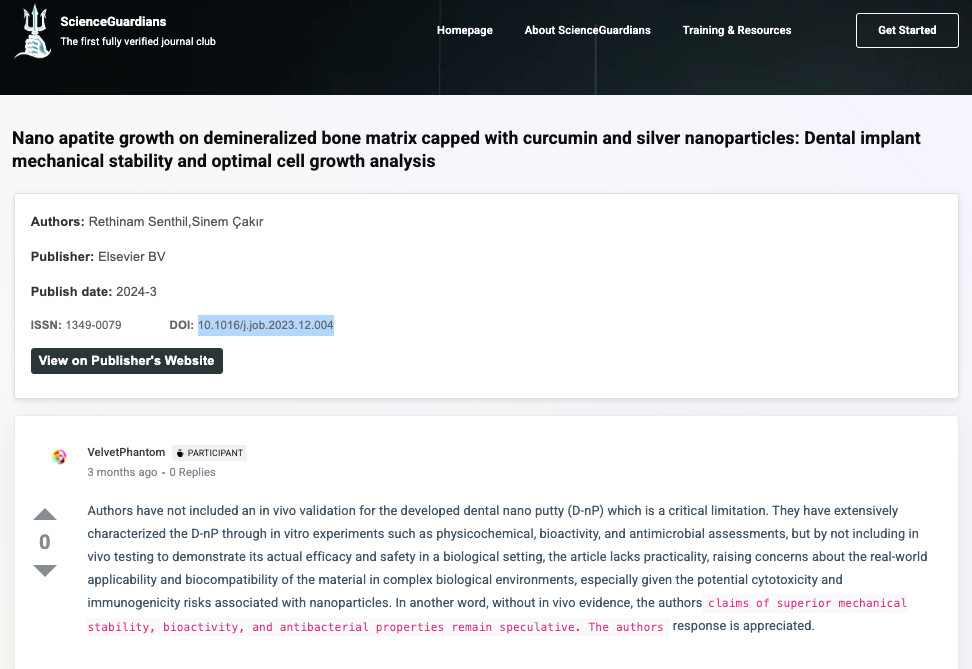
Screenshot of https://scienceguardians.com/topic/nano-apatite-growth-on-demineralized-bone-matrix-capped-with-curcumin-and-silver-nanoparticles-dental-implant-mechanical-stability-and-optimal-cell-growth-analysis/

It reads: 

Nano apatite growth on demineralized bone matrix capped with curcumin and silver nanoparticles: Dental implant mechanical stability and optimal cell growth analysis
Authors: Rethinam Senthil,Sinem Çakır
Publisher: Elsevier BV
Publish date: 2024-3
ISSN: 1349-0079
DOI: 10.1016/j.job.2023.12.004
View on Publisher's Website

VelvetPhantom
 Participant
3 months ago
0 Replies
Up
0
Down
Authors have not included an in vivo validation for the developed dental nano putty (D-nP) which is a critical limitation. They have extensively characterized the D-nP through in vitro experiments such as physicochemical, bioactivity, and antimicrobial assessments, but by not including in vivo testing to demonstrate its actual efficacy and safety in a biological setting, the article lacks practicality, raising concerns about the real-world applicability and biocompatibility of the material in complex biological environments, especially given the potential cytotoxicity and immunogenicity risks associated with nanoparticles. In another word, without in vivo evidence, the authorsclaims of superior mechanical stability, bioactivity, and antibacterial properties remain speculative. The authors response is appreciated.

Is it a COPE look-alike?

The ScienceGuardians website also features some training and resources, with flowcharts that resemble those used by COPE, the Committee on Publication Ethics. One flowchart covers the ethical reuse of figures and tables, another the addition of authors during the revision stage of submitted articles.

Who are the ScienceGuardians?

It is a bit unclear why ScienceGuardians set up a PubPeer-look-alike site and COPE-like guidelines, but of course, they are free to do so. As Oscar Wilde said, ‘Imitation is the sincerest form of flattery that mediocrity can pay to greatness‘.

But who is behind ScienceGuardians?

It might be tempting to speculate that the ScienceGuardians account and website could be run by a bunch of disgruntled scientists, whose papers have been criticized on PubPeer.

Only one person has publicly stated that they joined the platform: Dr. Wafik El-Deiry, a cancer researcher and Associate Dean for Oncologic Sciences at Brown University and the co-Editor in Chief of Oncotarget.
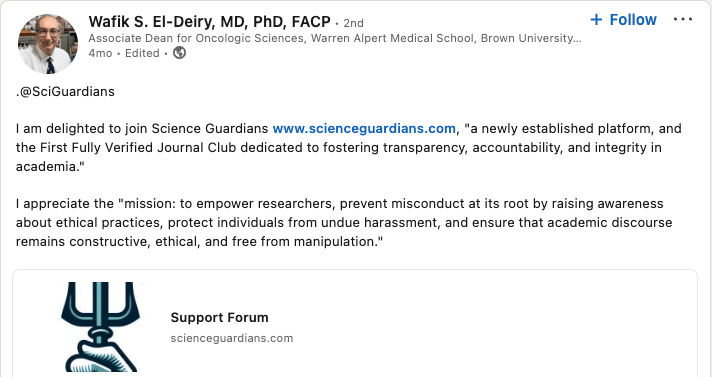
Screenshot from LinkedIn post by Wafik S El-Deiry, stating:

"View Wafik S. El-Deiry, MD, PhD, FACP’s  graphic link
Wafik S. El-Deiry, MD, PhD, FACPWafik S. El-Deiry, MD, PhD, FACP
 • 2nd2nd
Associate Dean for Oncologic Sciences, Warren Alpert Medical School, Brown University, Providence, RIAssociate Dean for Oncologic Sciences, Warren Alpert Medical School, Brown University, Providence, RI
4mo • Edited •  4 months ago • Edited • Visible to anyone on or off LinkedIn

Follow

.@SciGuardians 

I am delighted to join Science Guardians www.scienceguardians.com, "a newly established platform, and the First Fully Verified Journal Club dedicated to fostering transparency, accountability, and integrity in academia." 

I appreciate the "mission: to empower researchers, prevent misconduct at its root by raising awareness about ethical practices, protect individuals from undue harassment, and ensure that academic discourse remains constructive, ethical, and free from manipulation."

https://www.linkedin.com/posts/wafike_support-forum-activity-7267178247690272770-jkjG/
Archived: https://archive.ph/aMRGV

Dr. El-Deiry has published over 1,000 articles, as per Dimensions.ai. Before joining Brown University, he has worked at the Howard Hughes Medical Institute, the University of Pennsylvania, and Penn State University. According to his Wikipedia page, he has authored 13 papers that have been cited over 6,000 times.

He also has earned nearly 70 comments on PubPeer. They cover the usual range of duplicated and overlapping images. For a summary of the concerns raised on his papers, you can read this post on ForBetterScience.
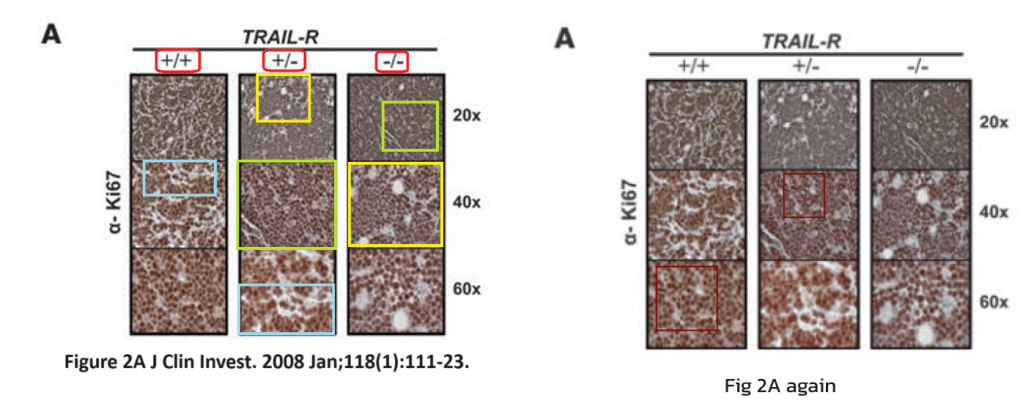
Screenshot of Figure 2 from a paper, showing 9 brownish colored panels with slices of tissues. Each panel shows a different experiment. Unexpectedly, several of these panels show overlap, as highlighted with boxes of the same color.

El-Deiry was not happy about his PubPeer comments

Dr. El-Deiry was, understandably, not happy with all those PubPeer comments about his papers.

But instead of addressing the concerns by looking up the original data and providing the correct images, Dr. El-Deiry replied to most PubPeer comments with a screenshot of a lengthy statement, in which he lamented that PubPeer ‘has no moral, legal, or any other authority to smear the reputation of numerous individuals publicly including on social media‘.

He also wrote ‘Underlying political motivations are extremely troubling as is the anonymous nature of public attacks‘, ‘political motives by anonymous accusers‘, and ‘blackmail and exploitation‘.
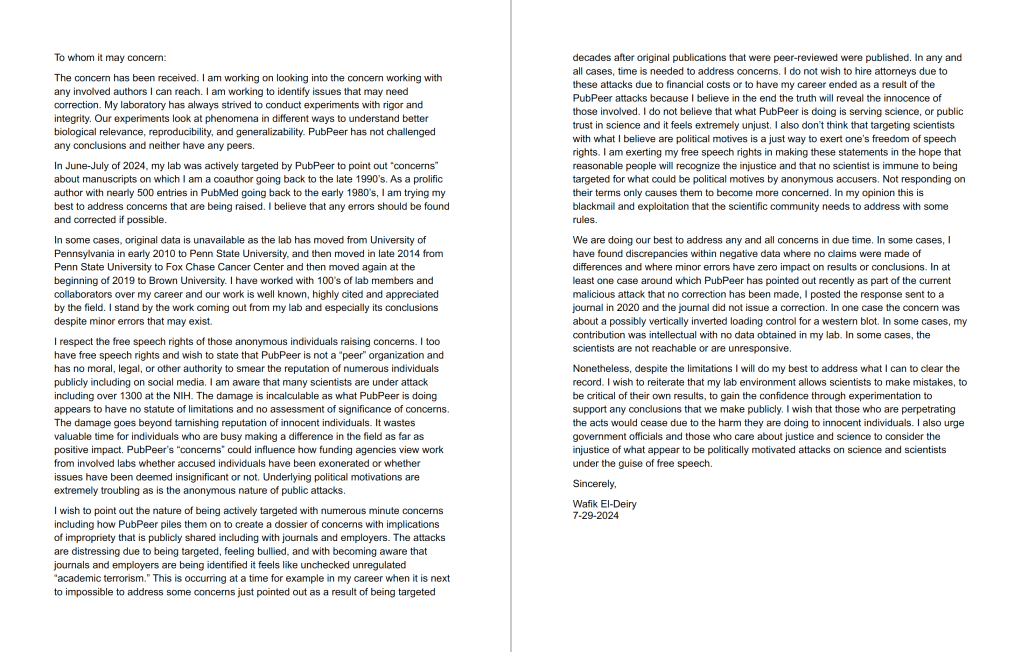
Screenshot of a long reply that El-Deiry posted on several PubPeer pages. It reads:

To whom it may concern: 
The concern has been received. I am working on looking into the concern working with any involved authors I can reach. I am working to identify issues that may need correction. My laboratory has always strived to conduct experiments with rigor and integrity. Our experiments look at phenomena in different ways to understand better biological relevance, reproducibility, and generalizability. PubPeer has not challenged any conclusions and neither have any peers. 
In June-July of 2024, my lab was actively targeted by PubPeer to point out "concerns" about manuscripts on which I am a coauthor going back to the late 1990's. As a prolific author with nearly 500 entries in PubMed going back to the early 1980's, I am trying my best to address concerns that are being raised. I believe that any errors should be found and corrected if possible. 
In some cases, original data is unavailable as the lab has moved from University of Pennsylvania in early 2010 to Penn State University, and then moved in late 2014 from Penn State University to Fox Chase Cancer Center and then moved again at the beginning of 2019 to Brown University. I have worked with 100's of lab members and collaborators over my career and our work is well known, highly cited and appreciated by the field. I stand by the work coming out from my lab and especially its conclusions despite minor errors that may exist. 
I respect the free speech rights of those anonymous individuals raising concerns. I too have free speech rights and wish to state that PubPeer is not a "peer" organization and has no moral, legal, or other authority to smear the reputation of numerous individuals publicly including on social media. I am aware that many scientists are under attack including over 1300 at the NIH. The damage is incalculable as what PubPeer is doing appears to have no statute of limitations and no assessment of significance of concerns. The damage goes beyond tarnishing reputation of innocent individuals. It wastes valuable time for individuals who are busy making a difference in the field as far as positive impact. PubPeer's "concerns" could influence how funding agencies view work from involved labs whether accused individuals have been exonerated or whether issues have been deemed insignificant or not. Underlying political motivations are extremely troubling as is the anonymous nature of public attacks. 
I wish to point out the nature of being actively targeted with numerous minute concerns including how PubPeer piles them on to create a dossier of concerns with implications of impropriety that is publicly shared including with journals and employers. The attacks are distressing due to being targeted, feeling bullied, and with becoming aware that journals and employers are being identified it feels like unchecked unregulated "academic terrorism." This is occurring at a time for example in my career when it is next to impossible to address some concerns just pointed out as a result of being targeted 
decades after original publications that were peer-reviewed were published. In any and all cases, time is needed to address concerns. I do not wish to hire attorneys due to these attacks due to financial costs or to have my career ended as a result of the PubPeer attacks because I believe in the end the truth will reveal the innocence of those involved. I do not believe that what PubPeer is doing is serving science, or public trust in science and it feels extremely unjust. I also don't think that targeting scientists with what I believe are political motives is a just way to exert one's freedom of speech rights. I am exerting my free speech rights in making these statements in the hope that reasonable people will recognize the injustice and that no scientist is immune to being targeted for what could be political motives by anonymous accusers. Not responding on their terms only causes them to become more concerned. In my opinion this is blackmail and exploitation that the scientific community needs to address with some rules. 
We are doing our best to address any and all concerns in due time. In some cases, I have found discrepancies within negative data where no claims were made of differences and where minor errors have zero impact on results or conclusions. In at least one case around which PubPeer has pointed out recently as part of the current malicious attack that no correction has been made, I posted the response sent to a journal in 2020 and the journal did not issue a correction. In one case the concern was about a possibly vertically inverted loading control for a western blot. In some cases, my contribution was intellectual with no data obtained in my lab. In some cases, the scientists are not reachable or are unresponsive. 
Nonetheless, despite the limitations I will do my best to address what I can to clear the record. I wish to reiterate that my lab environment allows scientists to make mistakes, to be critical of their own results, to gain the confidence through experimentation to support any conclusions that we make publicly. I wish that those who are perpetrating the acts would cease due to the harm they are doing to innocent individuals. I also urge government officials and those who care about justice and science to consider the injustice of what appear to be politically motivated attacks on science and scientists under the guise of free speech. 
Sincerely, 
Wafik EI-Deiry 7-29-2024

ScienceGuardians in full DARVO mode

The SciGuardians X-account appears to be doing precisely what El-Deiry claims to despise. It anonymously tries to smear the reputation of PubPeer commenters, by making all kinds of false accusations.

It follows the classical DARVO pattern, a term coined by Dr. Jennifer Freyd that stands for “Deny, Attack, and Reverse Victim and Offender.”

In a long tweet posted today, ScienceGuardians complains about science critic ‘Clare Francis‘ (a pseudonym) who has used several PubPeer accounts to post concerns about Dr. El-Deiry’s papers. In an attempt to DARVO these critiques, Francis is described as the villain, and Dr. El-Deiry as the victim. For example, Francis’s accounts are described as ‘fraudulent aliases‘, and their posts as ‘threats, disrespect, harassment, and extortion‘ with an ‘unrelenting obsession‘ and ‘orchestrated attacks, deceptive behaviors, and fraudulent tactics‘. Dr. El-Deiry is painted as the victim of ‘coordinated personal attacks’.

Of note, nothing in the gish-gallop of adjectives and bold-face statements in that tweet shows any proof of threats, fraud, or extortion.
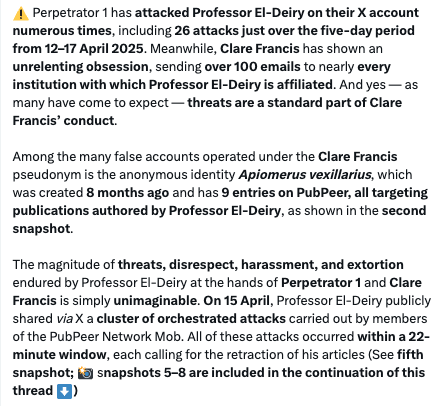
Screenshot from a very long tweet archived at https://archive.ph/higbG

"⚠️ Perpetrator 1 has attacked Professor El-Deiry on their X account numerous times, including 26 attacks just over the five-day period from 12–17 April 2025. Meanwhile, Clare Francis has shown an unrelenting obsession, sending over 100 emails to nearly every institution with which Professor El-Deiry is affiliated. And yes — as many have come to expect — threats are a standard part of Clare Francis’ conduct.
Among the many false accounts operated under the Clare Francis pseudonym is the anonymous identity Apiomerus vexillarius, which was created 8 months ago and has 9 entries on PubPeer, all targeting publications authored by Professor El-Deiry, as shown in the second snapshot.
The magnitude of threats, disrespect, harassment, and extortion endured by Professor El-Deiry at the hands of Perpetrator 1 and Clare Francis is simply unimaginable. On 15 April, Professor El-Deiry publicly shared via X a cluster of orchestrated attacks carried out by members of the PubPeer Network Mob. All of these attacks occurred within a 22-minute window, each calling for the retraction of his articles (See"

On April 11, SciGuardians tweeted about the ‘Coordinated Attacks on the Scientific Community‘ by PubPeer users who criticized papers by Dr. Sabine Hazan and Professor Jörg Rinklebe, who has earned a whopping 288 PubPeer posts.

In an April 10 SciGuardians post, the retraction of a paper by Dr. Sabine Hazan from Frontiers in Microbiology was described as ‘unjustified‘, ‘premature‘, and ‘a case in point of how commercially-driven decisions can distort the scientific process, stifling innovation and inquiry‘.
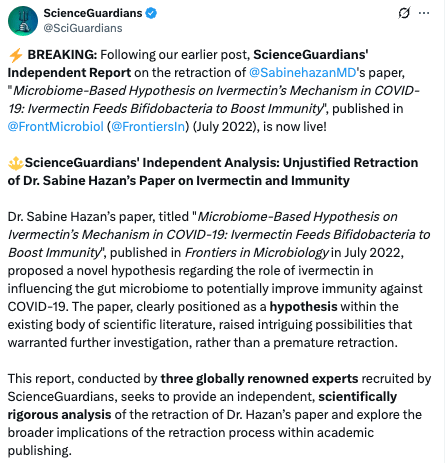
Screenshot from a tweet archived here: https://archive.ph/g5UR7


⚡️ BREAKING: Following our earlier post, ScienceGuardians' Independent Report on the retraction of 
@SabinehazanMD
's paper, "Microbiome-Based Hypothesis on Ivermectin’s Mechanism in COVID-19: Ivermectin Feeds Bifidobacteria to Boost Immunity", published in 
@FrontMicrobiol
 (
@FrontiersIn
) (July 2022), is now live!

🔱ScienceGuardians' Independent Analysis: Unjustified Retraction of Dr. Sabine Hazan’s Paper on Ivermectin and Immunity

Dr. Sabine Hazan’s paper, titled "Microbiome-Based Hypothesis on Ivermectin’s Mechanism in COVID-19: Ivermectin Feeds Bifidobacteria to Boost Immunity", published in Frontiers in Microbiology in July 2022, proposed a novel hypothesis regarding the role of ivermectin in influencing the gut microbiome to potentially improve immunity against COVID-19. The paper, clearly positioned as a hypothesis within the existing body of scientific literature, raised intriguing possibilities that warranted further investigation, rather than a premature retraction.

This report, conducted by three globally renowned experts recruited by ScienceGuardians, seeks to provide an independent, scientifically rigorous analysis of the retraction of Dr. Hazan’s paper and explore the broader implications of the retraction process within academic publishing.

The ScienceGuardians’ use of libelous language

By using sensational language including words like ‘breaking‘, ‘uncovering‘, and ‘revealing‘, the @SciGuardians account is trying to pique interest.

The account has promised to reveal ‘evidence of fraud, identity manipulation, and coordinated misconduct‘ – but so far, all it has done is show that there are some prolific PubPeer users who have posted numerous concerns about Dr. El-Deiry’s and Dr. Hazan’s papers. Duh, that is hardly breaking news. And not fraudulent at all.
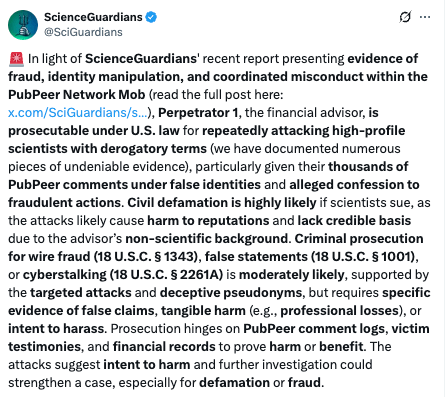
Screenshot from a post by ScienceGuardians, archived here: https://archive.ph/csD17
It reads: 
"🚨 In light of ScienceGuardians' recent report presenting evidence of fraud, identity manipulation, and coordinated misconduct within the PubPeer Network Mob (read the full post here: https://x.com/SciGuardians/status/1911572653942452574), Perpetrator 1, the financial advisor, is prosecutable under U.S. law for repeatedly attacking high-profile scientists with derogatory terms (we have documented numerous pieces of undeniable evidence), particularly given their thousands of PubPeer comments under false identities and alleged confession to fraudulent actions. Civil defamation is highly likely if scientists sue, as the attacks likely cause harm to reputations and lack credible basis due to the advisor’s non-scientific background. Criminal prosecution for wire fraud (18 U.S.C. § 1343), false statements (18 U.S.C. § 1001), or cyberstalking (18 U.S.C. § 2261A) is moderately likely, supported by the targeted attacks and deceptive pseudonyms, but requires specific evidence of false claims, tangible harm (e.g., professional losses), or intent to harass. Prosecution hinges on PubPeer comment logs, victim testimonies, and financial records to prove harm or benefit. The attacks suggest intent to harm and further investigation could strengthen a case, especially for defamation or fraud."

In several posts (here and here), SciGuardians discusses the ‘coordinated attacks’ by Pubpeer ‘perpetrators‘, a term suggesting illegal or fraudulent activities.

In fact, by using words such as ‘perpetrator‘, ‘false identities‘, ‘wire fraud‘, ‘prosecution‘, ‘confesses‘, and ‘expose‘, they make a nothing-burger out of showing that some people post under a pseudonym, just like folks at the ScienceGuardians’ website do! Ain’t nothing wrong or fraudulent with using a pseudonym.

Is ScienceGuardians related to CureGuardian?

The style of SciGuardians’ tweets reminds me of those by Matt Nachtrab, who relentlessly harassed me after I criticized papers related to his beloved $SAVA company – and who lost $50 million by ignoring our repeated warnings. You can find some examples of his tweets here, here, here, and here.

In an interesting detail, Matt was so angry with our PubPeer comments that he started CureGuardian.org – a name uncannily similar to ScienceGuardians.com. Might they be related? 🤔 (just speculating here!)

Left:screenshot of a tweet by Matt Nachtrab that was archived here: https://archive.ph/VtIP3

Right: Screenshot of the website: https://cureguardian.org/

Becoming ScienceGuardians

The ScienceGuardians’ website claims to be a ‘global hub for upholding the highest standards of integrity‘ and a ‘beacon of trust and accountability‘ seem to not match the libelous language they spout on X very well. But… freedom of speech and all of that, right?

Anyone can become a member of their platform, as long as you have an email address associated with an academic or publishing institution – no luck trying to sign up with your gmail account. They claim to be inclusive, where ‘every member, regardless of their role in the scienceguardians community, can share their insights and concerns. This inclusivity ensures that the perspectives of all stakeholders are respected and considered.’

So I just signed up with my Stanford affiliate email address. Let’s see how inclusive they are. Will they approve my membership?

Update: Unexpectedly, ScienceGuardians approved my membership the next day. I could even copy/paste some PubPeer comments, which I did for a week or so. Apparently, I am now the most prolific Science Guardian, hahaha.

3 thoughts on “ScienceGuardians, where disgruntled authors complain about PubPeer”

  1. Are you concerned that they may cite your participation Indianapolis to show that their site is legitimate?

    Like

Leave a reply to Mary Kuhner Cancel reply