On some days, after hours of image scanning, I feel like doing something different. Today, I searched for some scientific papers containing “tortured phrases”. This term was first coined by Guillaume Cabanac et al. in a 2021 preprint.
Tortured phrases are bizarrely synonymized versions of standard scientific terms produced when authors run copied text through paraphrasing or translation software to disguise plagiarism. This can lead to funny sounding word combinations, such as “bosom malignancy” instead of “breast cancer“.
Today, I found a beautiful example of synonymized plagiarism involving the microbiome of a camel’s udder.
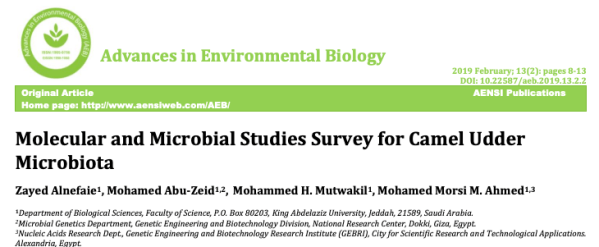
The paper in question is called Molecular and Microbial Studies Survey for Camel Udder Microbiota, published in Advances in Environmental Biology (2019), DOI: 10.22587/aeb.2019.13.2.2 [PubPeer].
This appears to be a very l0w-quality journal, published by The American-Eurasian Network for Scientific Information (AENSI), which states that “AENSI Journal exists to publish results of research in the all area of science and Technology.” The AENSI publisher has been listed among potential predatory publishers, e.g. in Beall’s List.
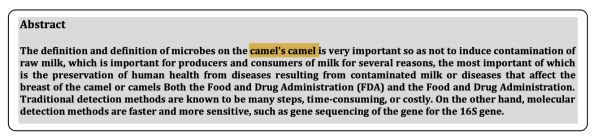
But I digress. You are here for the camel’s camel. It’s right there in the abstract, which reads:
The definition and definition of microbes on the camel’s camel is very important so as not to induce contamination of raw milk, which is important for producers and consumers of milk for several reasons, the most important of which is the preservation of human health from diseases resulting from contaminated milk or diseases that affect the breast of the camel or camels Both the Food and Drug Administration (FDA) and the Food and Drug Administration.
Traditional detection methods are known to be many steps, time-consuming, or costly. On the other hand, molecular detection methods are faster and more sensitive, such as gene sequencing of the gene for the 16S gene.
I felt out of breath after reading that first sentence! But yes, let’s learn more about the definition and definition of microbes on the camel’s camel! Such an exciting topic.
Tortured phrases
The paper systematically replaces common microbiology terms with bizarre synonyms and paraphrases. Here are some nice examples:
| Paper wording | Normal wording |
|---|---|
| creature assortment | genus |
| beast swarm | animal hosts |
| cubicle | bacterial cell |
| biological specialties | ecological niches |
| destructiveness parts | virulence factors |
| saw sorts | recognized species |
| minuscule life forms | bacteria |
| mentality heart imbuement | Brain Heart Infusion medium |
Some other sentences in this paper that your brain might have some trouble with processing:
- “Current genomic approaches are nisus to discover the premise of various bacterial phenotypes by predicting the result of flexible changes occurring in the midst of the improvement of mortal masses.”
- “Because of this physical cell increment, reducing its monetary esteem.”
- “Anticapsular antibodies were appeared to give defensive invulnerability in a creature demonstrate, so particular intrigue has been set on the investigation of the container and its potential as an objective for immunization against GBS”
- “By differentiate, a dN/dS < 1 proposes the nearness of sanitizing determination and the protection of protein work.”
Plagiarized from a PhD thesis
Usually, such tortured phrases are signs of copied-and-pasted text from another source, with the text synonymized to avoid detection by a plagiarism checker. Today, one can simply use a generative AI model to rewrite such text, of course, but this paper is from 2019, when such tools were not yet commonplace.
It’s not always easy to translate sentences with those synonymized terms back into regular English and find the original text. But it did not take me too long to find the most likely source for the camel udder paper: A 2017 PhD thesis by Alexandre Almeida at the Université Pierre et Marie Curie in Paris.
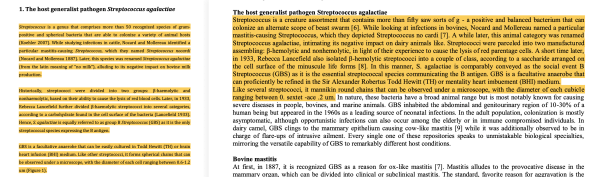
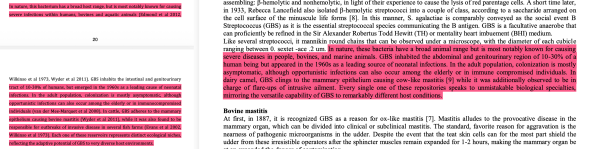
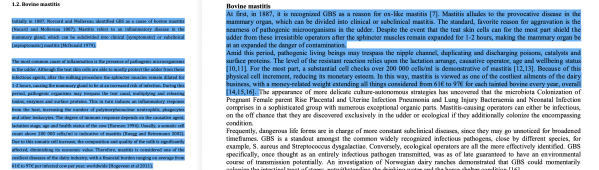
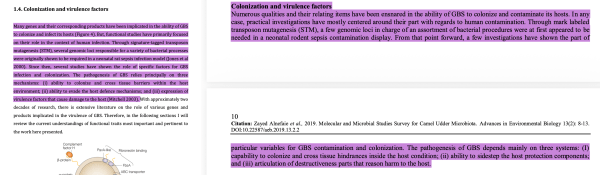
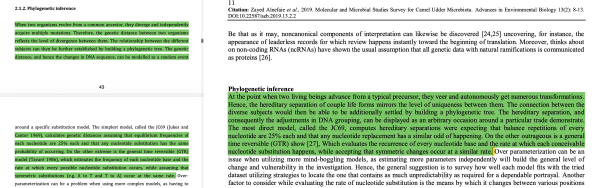
Here are some side-by-side screenshots. On the left, the 2017 PhD thesis (the original text), and on the right, the 2019 camel udder paper.
A stolen figure with non-udders
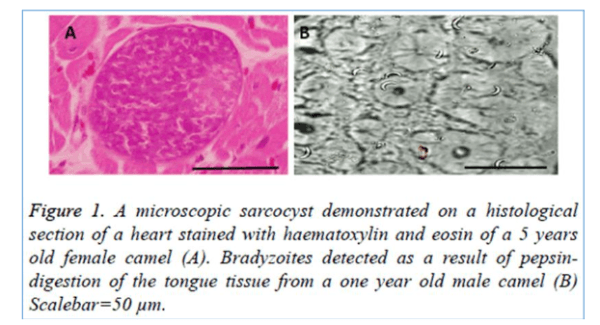
Figure 1 from the paper appears to be a screenshot (with caption and all) from Omer et al., Biomedical Research (2017), no DOI, available here: https://www.alliedacademies.org/articles/prevalence-and-molecular-detection-of-sarcocystis-spp-infection-in-the-dromedary-camel-camelus-dromedarius-in-riyadh-city-saudi-ar.html
No udder is to be seen here, although we can appreciate the completely irrelevant photos of an infected camel’s heart and tongue. At least it is better than a camel toe (NSFW)!
But wait, the authors wrote another camel udder microbiome paper!
Other than the introduction, the whole camel udder microbiome paper is not about the camel udder microbiome – how dumb of me to expect that – but about virulence factors and genetics of Streptococcus agalactiae (Group B Streptococcus or GBS).
That is funny, because if you search for the first author’s name, Google’s AI claims that “His research, such as the 2019 study published in Advances in Environmental Biology, contributes to understanding bacterial communities in camels.”
But perhaps that is because three of the four authors did indeed publish another paper about the camel udder microbiota, called Molecular Identification for Camel Udder Microbiota, also published in Advances in Environmental Biology, one month later, in March 2019.
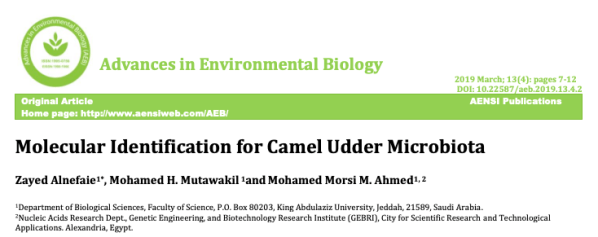
This second paper also has some funny-sounding phrases, that might be the result of synonymized text:
- “Camel drain is considered a standout amongst the essential nourishment sources…”
- “Camel udder microbiota is critical because It can survive and produce meat and milk.”
- “Mastitis stays to be the most critical monetary ailment impediment amid dairy cows around the world.”
- “In any case, camels are kept in framework and asset poor peripheral territories.”
Editorial fail
How a paper containing sentences like these passed peer review is hard to understand. The journal Advances in Environmental Biology is published by AENSI, a publisher that has appeared on lists of potential predatory publishers and operates a cluster of similarly named journals. When editorial oversight is weak and peer review is non-existent, sentences about “definition and definition of microbes on the camel’s camel” can end up in the scientific literature. And once published, such papers can be indexed, cited, and even summarized by AI tools as legitimate scientific contributions.
In the end, the most memorable scientific contribution of this paper may not be its findings on the camel microbiota, but the unforgettable discovery that microbes live on “the camel’s camel.”

 Science Integrity Digest
“Beast Swarm” – wasn’t that a double IPA from Rogue Brewers?
LikeLike
What a wonderful lecture. Thank you for putting a smile on my Monday face! My personal camel’s camel feels now much more better (as the Germans say).
LikeLike