A 2025 paper published in Ophthalmic Epidemiology is being promoted online as proof that COVID-19 vaccines damage the eyes. Before accepting that conclusion, it was worth looking at the paper itself.
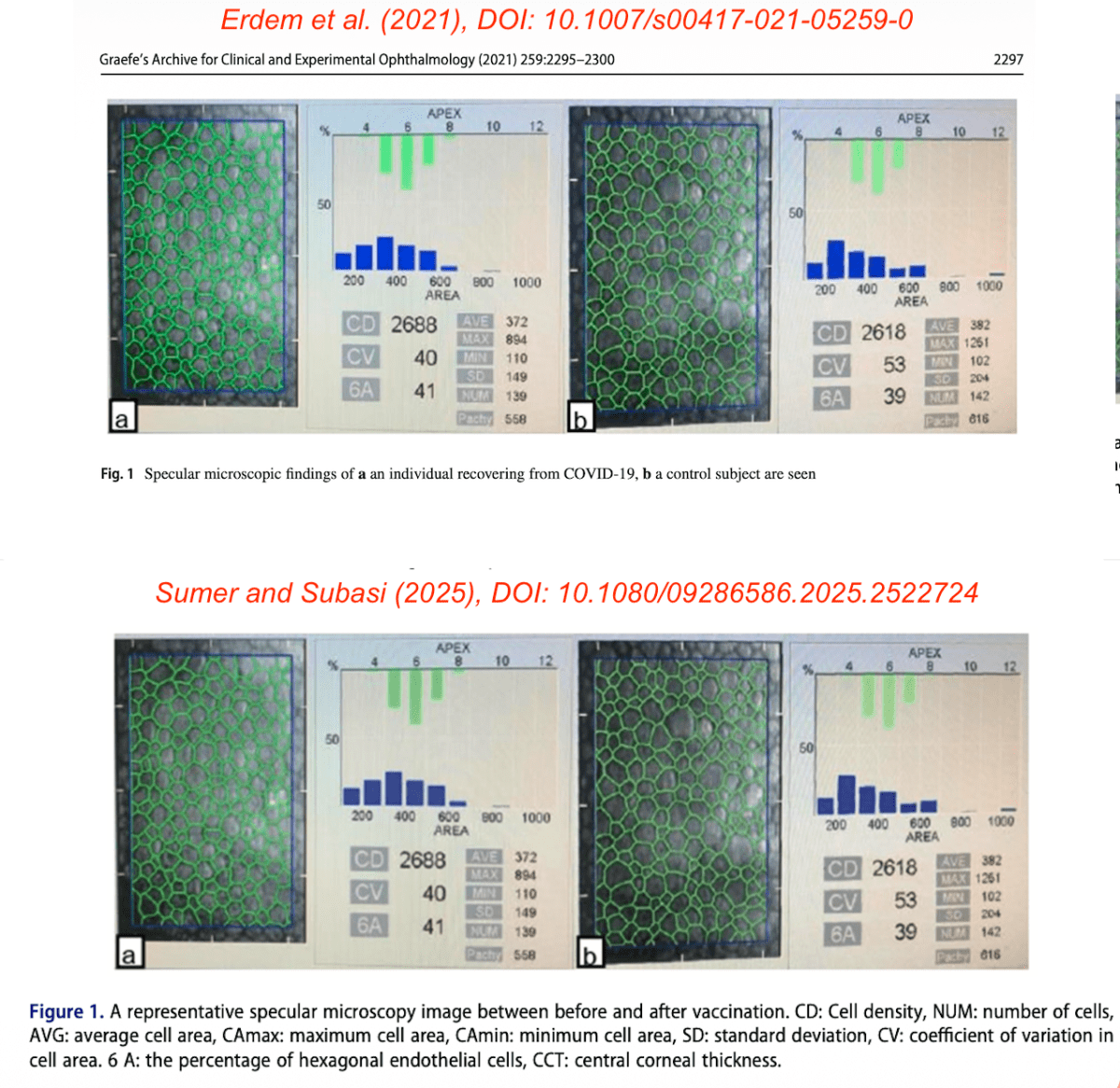
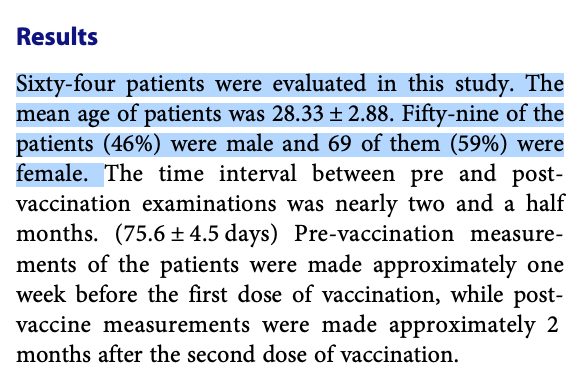
A closer look at the article revealed a reused figure published by another group of authors, 59 men plus 69 women in a study of 64 participants, no control group, and an ethics approval number that seems generic and incomplete.
A study on the eyes of volunteers vaccinated for COVID-19
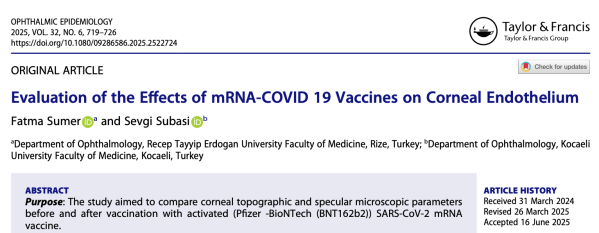
The claim is based on a 2025 paper by Fatma Sumer and Sevgi Subasi, “Evaluation of the Effects of mRNA-COVID 19 Vaccines on Corneal Endothelium“, published in Taylor & Francis’ Ophthalmic Epidemiology, DOI: 10.1080/09286586.2025.2522724 (where it costs a whopping $64 to download!).
The study followed 64 healthy volunteers who underwent eye examinations before vaccination with the Pfizer BioNTech SARS-CoV-2 mRNA vaccine, and again approximately 75 days later. The authors reported statistically significant changes in several measurements of the corneal endothelium, including lower endothelial cell density (ECD), increased coefficient of variation (CV), reduced hexagonality, and increased central corneal thickness. Now, these terms might not be familiar to everyone (they certainly did not mean much to me), but it basically meant that the authors found fewer specialized corneal cells, and that the remaining cells appeared more irregular. In ophthalmology, that is generally interpreted as a less healthy corneal endothelium.
The study did not report blindness, vision loss, or clinically apparent eye disease. Nor does it include an unvaccinated control group. Instead, participants served as their own controls, with measurements taken before and after vaccination.
That does not mean the findings are necessarily wrong. However, before using this paper as evidence that COVID-19 vaccination causes permanent eye damage, it is worth looking at the paper itself.
And unfortunately, there were some problems.
Figure 1 appears to have been taken from a 2021 study by different authors
Of most concern, Figure 1 of the Sumer & Subasi (2025) study looks identical to Figure 1 of Erdem et al., “Examination of the effects of COVID 19 on corneal endothelium“, Graefe’s Archive for Clinical and Experimental Ophthalmology (2021) 259:2295–2300, DOI: 10.1007/s00417-021-05259-0.
The figures look exactly the same, with the same two specular microscopy images and identical numerical values (e.g., CD 2688/CV 40/6A 41 and CD 2618/CV 53/6A 39).
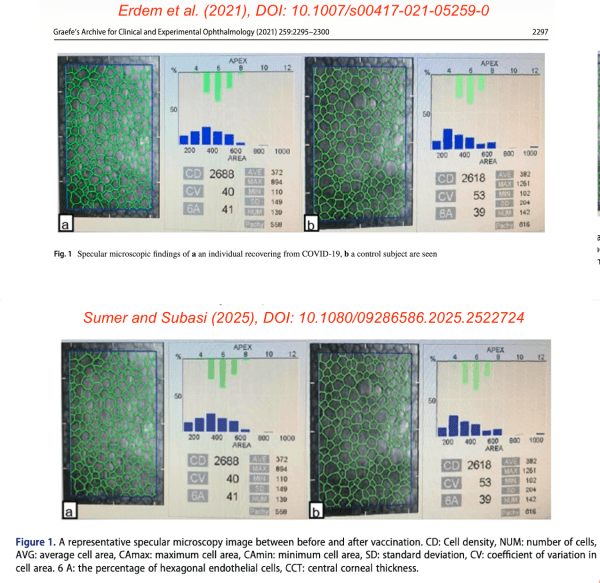
However, the figures are described differently: in Erdem et al., they represent eye measurements from a recovering COVID-19 patient and a control subject, whereas in Sumer & Subasi they represent pre- and post-vaccination measurements. Those are comparing different groups of patients! [Note that the descriptions of a) and b) in the Erdem paper might have been switched by accident, but that is not the point of my concerns here.]
Erdem et al. 2021 is cited in the Sumer & Subasi 2025 paper (in the Discussion), but not in the context of this figure. Of additional concern, the two papers are from different authors and affiliations, although both are from Turkish institutions.
Sumer & Subasi list the Recep Tayyip Erdogan University Faculty of Medicine and the Kocaeli University Faculty of Medicine as their affiliations, while Erdem et al. are affiliated with the Dicle University Medical Faculty.
So it appears that Sumer & Subasi reproduced a figure from a different research group and study and presented it as originating from their own study. This casts doubt over whether the patient group and measurements they described actually existed.
Implausible demographic data
Second, the demographic data in the Sumer & Subasi study appear internally inconsistent. The paper states that 64 patients were enrolled, but reports 59 male and 69 female participants. These numbers add up to 128, not 64.
The percentages also add up to 105%, which is remarkable as well.
One possible explanation is that the authors accidentally reported the number of eyes rather than the number of participants. However, that explanation creates a new problem: sex is generally assigned to people, not to individual eyes. If 59 eyes were male and 69 eyes were female, at least one participant would appear to have one male eye and one female eye, which would be a remarkable biological finding not discussed elsewhere in the paper.
This raises questions about the reliability of the reported demographic data and clinical parameters.
Strange ethics approval number
Third, the ethics statement provides only the number “##40465587#“. Other publications from the Recep Tayyip Erdogan University also use this number, but as part of a much longer ethics approval identifier. For example, I found ethics approval numbers in other papers affiliated with that university written as follows:
- 2021/E-40465587-050.01.04-9 in DOI: 10.62425/jmefm.1559901
- E-40465587-050.01.04-1300 in DOI: 10.3390/jcm15072480
- E-40465587-050.01.04-707 in DOI: 10.3390/jcm14051516
- E-40465587-050.01.04-730 in DOI: 10.4103/gmit.gmit_19_24
The number 40465587, therefore, might just be telling us it is from the Recep Tayyip Erdogan University. It is therefore unclear whether the complete approval number was inadvertently omitted.
No control group
The authors compare participants to themselves 2.5 months later. Any change could be caused by measurement drift, technician or device effects, seasonal variation, etc. Without a proper age-matched control group (which the authors could have easily done), this study is not set up properly to evaluate the effects of the vaccination.
Final thoughts
None of these observations prove that the study’s conclusions are wrong. However, they do raise questions about the reliability of the manuscript and deserve clarification from the authors and journal.
The paper is currently being cited on social media as evidence that COVID-19 vaccination causes permanent eye damage. Before drawing such conclusions, it would be helpful to know why the paper appears to reuse images from an earlier study, how a study of 64 participants ended up with 59 men and 69 women, and what the complete ethics approval number was. Until those questions are answered, I would be cautious about placing too much weight on the reported findings.


