On some days, after hours of image scanning, I feel like doing something different. Today, I searched for some scientific papers containing “tortured phrases”. This term was first coined by Guillaume Cabanac et al. in a 2021 preprint.
Tortured phrases are bizarrely synonymized versions of standard scientific terms produced when authors run copied text through paraphrasing or translation software to disguise plagiarism. This can lead to funny sounding word combinations, such as “bosom malignancy” instead of “breast cancer“.
Today, I found a beautiful example of synonymized plagiarism involving the microbiome of a camel’s udder.
Over the past couple of days, I have been reviewing a series of Materials Science papers, all co-authored by the same group of researchers from the Universities of Lahore, Chakwal, and Sargodha in Pakistan. While reviewing them, one analytical technique kept standing out for unusual reasons.
“Patients with provocative entrail illness unclassified gave to crisis division a 3-day history of sickness, retching, migraine and irregular stomach torment alongside discontinuous ridiculous stools as of late.”
If you cannot wrap your brain around this sentence, don’t worry. Neither can I.
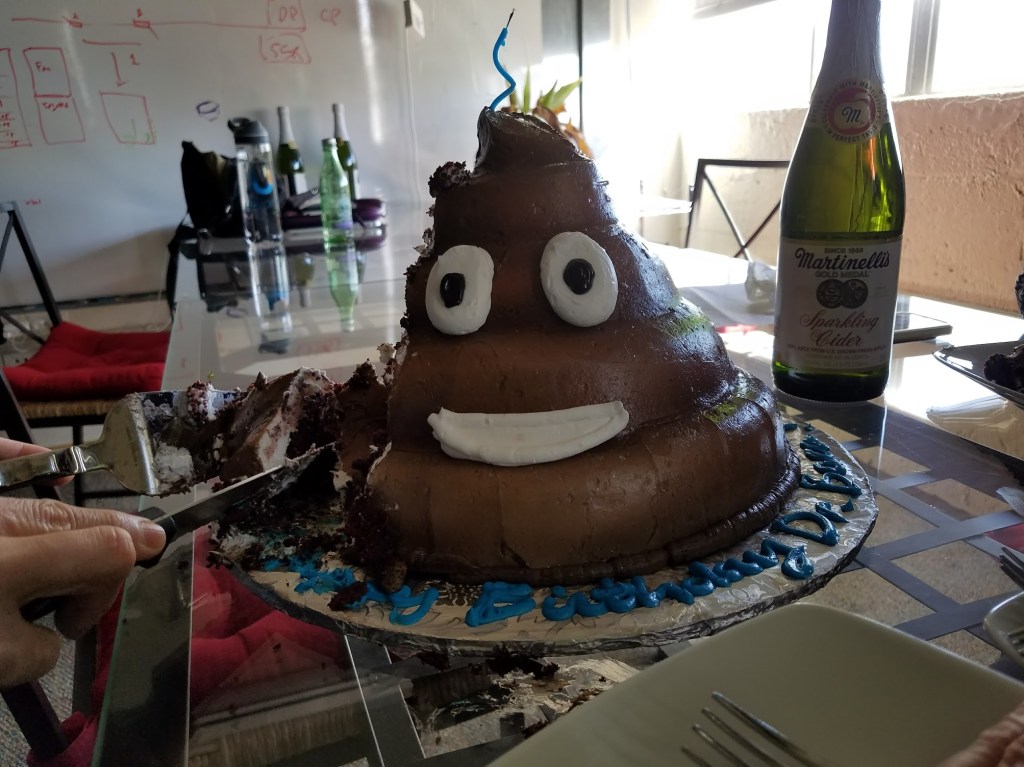
A photo of a very ridiculous stool: a poop-emoji cake, with big white googly eyes and twisted candles on top. Taken at uBiome headquarters, March 2017.
Today, 25 July 2025, a preprint was posted claiming that significant gene expression changes were found in individuals with new-onset cancer and other diseases after receiving mRNA COVID-19 vaccines, compared to healthy individuals.
A preprint is a non-peer reviewed manuscript – a study or hypothesis that has not yet been evaluated by other scientists. These articles should always be read with caution. Preprints can be brilliant, misguided, or completely bonkers – but they have not been peer-reviewed.
So let’s take a closer look at this preprint.
Update, 12 September 2025: The preprint was withdrawn for “unresolved ethical issues concerning ethical oversight, legitimacy of institutional boards, validity of the study design, and potential biases in study interpretation that compromise the overall trust in the research findings.“
It is hard to find the time to post here. I’m getting lots of requests to help scanning papers for image problems, and am also traveling a lot to give talks and be in panels. So my ‘monthly’ digests have now turned into quarterly digests, hahaha.
These past months, I have traveled to Berlin to receive the Einstein Foundation Award, to Oxford for the FAIRS Meeting, participated in a workshop in Stockholm organized by the Royal Swedish Academy of Sciences about the Reformation of Science Publishing, a conference in London at the Royal Society about the Future of Science Publishing, and a gathering with other science detectives and journalists in Krakow, Poland. In between, I gave several talks at research institutions and medical schools. I am getting pretty good at packing suitcases!
Here is a round-up of some noteworthy articles about research integrity.
Apologies for not posting for a while. Fall 2024 was a busy time for me, with travel to give talks in Australia and Singapore and some events in the US. Instead of trying to catch up with everything that has happened since September, here are some highlights.
Einstein Foundation Award
I’m thrilled to have won the 2024 Einstein Foundation Award for Promoting Quality in Research. The Einstein Foundation Berlin selects three winners each year. The 2024 winners are:
Early Career Award: Helena Jambor and Christopher Schmied at PixelQuality – Best practices for publishing images. ‘PixelQuality has established guidelines and checklists for publishing clear and reproducible images. It now aims to disseminate and refine them to handle AI-assisted image generation and analysis.’ ‘Research images are the proof of scientific findings, not just visuals. PixelQuality has set new standards for their reproducibility and transparency.’
Institutional Award:PubPeer – ‘PubPeer has become an essential part of the research communication landscape, with over 300,000 comments logged so far. It is estimated that since 2012, 19 percent of all retractions of papers worldwide in all academic domains had a prior discussion on the site. Beyond identifying flaws and fraud, PubPeer functions as an important tool to jointly improve scientific publications through „liquid feedback“.’
Individual Award:Elisabeth Bik – ‘Elisabeth Bik’s work in uncovering manipulated images, fraudulent research data and publications has created enormous impact all over the world. Her work has led to heightened awareness of questionable research practices and generated widespread attention to responsible conduct of research in the scientific community.’
The award ceremony will take place in March 2025 in Berlin, Germany.
The Einstein Foundation Award trophy is a piece of chalk, created by Professor Axel Kufus at the Berlin University of the Arts to honor ‘a basic tool that has been used to bring knowledge into the world for as long as we can remember’. Source: https://award.einsteinfoundation.de/about
The Bik Fund
Instead of accepting the Einstein Foundation award money for myself, I’ve decided to put it into ‘The Elisabeth Bik Science Integrity Fund’ – where I hope to help other science sleuths with small grants for e.g., traveling to conferences, buying equipment or software, or training. Our type of work often does not fit into the hypothesis-driven model of government or charity funds, so I hope to help by filling this funding gap.
It is my hope that we can make this fund grow, so we can help more integrity warriors in the future – donations to the Bik fund are tax-deductible and very welcome.
The book describes how Matthew Schrag, a neuroscientist at Vanderbilt University and a fellow image-sleuth, discovered possibly altered images in a highly-cited paper about amyloid plaques in Alzheimer’s patients and in other papers connected to the biotech company Cassava Sciences (see also below). It also gives a disturbing insight into the amount of fraud in neuroscience and the lack of action by journals, institutions, and government agencies.
Matthew Schrag and other ‘science sleuths’—Kevin Patrick, Mu Yang, and I—worked for two years checking thousands of papers in Alzheimer’s research and related fields for the book, uncovering a concerning number of potential problems in papers by Sylvain Lesné, Berislav Zlokovic, Eliezer Masliah, and others.
Charles Piller (right) and I at a book signing event for ‘Doctored’ – February 2025 at the Commonwealth Club in San Francisco, CA
Cassava Sciences Phase 3 did not work
I have written in the past (here and here) about problematic images in papers by Dr. Hoau-Yan Wang and Cassava Sciences (NASDAQ: $SAVA), a biotech company testing a drug targeting Alzheimer’s disease. These concerns were first spotted by Matthew Schrag and published in a Citizen Petition, in an attempt to halt Cassava’s clinical trials. Despite the apparent problems, the FDA did not stop Cassava’s clinical trials of their Alzheimer’s drug, Simufilam. But Cassava’s stock dropped significantly, upsetting a lot of investors.
For three years, fans of the $SAVA stock harassed the Dr. Wang critics – including me – claiming that the drug would work fine; that all stockholders would be rich as long as they would HODL; and that all our concerns were FUD. They joined forces in a SAVAges Discord app, where they talked about how one day they would all buy Maseratis, Lamborghinis, and even a SAVA island — and how retarded and fraudulent the SAVA-critics were.
The authorities begged to differ, however. In March 2024, Science reported that FDA inspectors had found many problems in Dr. Wang’s lab, ranging from uncalibrated instruments, lack of control samples, and stored data files, to leaving out outliers based on subjective criteria. Another report by the City University of New York (CUNY) to the Office of Research Integrity (ORI), leaked to Science, described ‘egregious misconduct’ in Dr. Wang’s lab. In June last year the Department of Justice announced that Professor Wang had been charged with operating a ‘Multimillion-Dollar Grant Fraud Scheme’.
Meanwhile, lawsuits were filed back-and-forth. Cassava Sciences was suing the people who filed the FDA citizen petition and who set up the website CassavaFraud.com, while stockholders were suing Cassava in a class-action lawsuit for misrepresenting the quality of the experiments performed by Dr. Wang. The Securities and Exchange Commission (SEC) charged Cassava with misrepresenting clinical trials result, and later settled for $40M. And CUNY, instead of officially announcing their misconduct findings, was investigating who leaked their misconduct investigation report to Science.
Finally, last December the biotech company announced that the Phase 3 trial did not meet the anticipated endpoints. In other words, Simufilam did not halt or improve Alzheimer’s disease. The Cassava Sciences stock immediately dropped to $2-3 dollars, and the SAVAges Discord became a valley of despair. No more SAVA island.
Didier Raoult enters the Retraction Watch Leaderboard
As I’ve written previously, many papers from Professor Didier Raoult, the former director of the IHU Méditerranée Infection in Marseille, France, are problematic.
Some appear to contain manipulated images, while others describe research conducted without proper ethical permits. A number of Raoult’s studies were performed on vulnerable populations, such as homeless people, or on study participants in the Global South, which I [gasp!] dared to label neocolonial science.
As described in this paper by Fabrice Frank et al, the IHU-MI produced a set of 248 studies all with the same IRB approval number, 09–022. Despite sharing the same permit, the publications varied in terms of sample type, demographics, and countries. Other ‘multi-use’ IRB numbers were found too. Typically, an IRB approves one particular study, and researchers are not allowed to reuse this permit for other, unrelated, studies. Dr. Raoult appears to have cared little for such rules, however.
After raising our concerns on PubPeer and social media, and also writing to journal editors, several journals have started to issue Expressions of Concern and retractions.
In fact, Raoult has now earned so many retractions (32 as of today) that he has entered the Retraction Watch Leaderboard. The most significant of them is the retraction of the paper that claimed that Hydroxychloroquine could treat COVID-19. I criticized this paper in my blog post in April 2020, days after its publication. It took more than four years to get it retracted.
With over 600 of his papers on PubPeer and 225 EoCs, it seems safe to assume that for Raoult’s position on the Retraction Watch Leaderboard list, the only way is up.
An overview of general news and articles about science integrity and some cases that I have worked on.
Science sleuths
The Rise of the Science Sleuths – When an Alzheimer’s paper came under scrutiny, correcting the scientific record meant battling much bigger problems – Jessica Wapner – Undark
The US Office of Research Integrity updated its regulations on handling research misconduct allegations. Key updates include clarifying the inquiry process and adjusting how institutions should handle the allegations and record the process.
James Heathers published a preprint arguing that the old, often-cited number that 2% of papers are fake is outdated and a vast underestimate. In a new preprint, he argues it might be 1 in 7 papers, based on 12 studies that together analyze 75,000 scientific articles.
How a Scientific Dispute Spiralled Into a Defamation Lawsuit – What does a Harvard Business School professor’s decision to sue the professors who raised questions about her research bode for academic autonomy? By Gideon Lewis-Kraus – New Yorker
New academic AI guidelines aim to curb research misconduct. The Chinese Academy of Sciences (CAS), the country’s top science institute, on Tuesday published new guidelines on the use of artificial intelligence (AI) in scientific research, as part of its efforts to improve scientific integrity and reduce research misconduct, such as data fabrication and plagiarism. – Zhang Weilan – Global Times
New Publication and Editorials
Quantifying Data Distortion in Bar Graphs in Biological Research. We developed a framework to quantify data distortion and analyzed bar graphs published across 3387 articles in 15 journals, finding consistent data distortions across journals and common biological data types. – Lin and Landry – bioRxiv
The Academic Culture of Fraud. The trustees maintain that the fraud arose from “lab culture and management,” and therefore implicitly that there is no single individual who bears moral or procedural responsibility for actually falsifying the data. – Ben Landau-Taylor – Palladium
Journal of Molecular Liquids vs One-Man Papermills – Mu Yang catches two crooks, Ayman Atta and S Muthu, who flooded one Elsevier journal (and several others) with ridiculous hand-drawn fraud. Whom to believe, the peer review, or your own eyes? – Leonid Schneider – For Better Science
With Random Precision. Papermills continue to appear on the scene (or rather, they have been there all along, waiting to be noticed) and once again we find ourselves with shovels and brooms, cleaning up after the performing elephants. – Smut Clyde – For Better Science
Scientific whistleblowers can be compensated for their service. To help correct the incentives, Ben Laundau-Taylor suggests that science could borrow an idea from the US financial system, where an SEC bounty program pays whistleblowers 10-30% of the fines imposed by the government. – Chris Said
Oxford Brookes professor awarded for academic integrity work – Professor Mary Davis has been given a National Teaching Fellowship, which celebrates individuals who have made an outstanding impact on student outcomes and teaching in higher education. – OxfordMail
Senior biochemist made up data in 13 studies – US Office of Research Integrity report aligns with investigation by the University of Maryland, Baltimore -Dalmeet Singh Chawla, special to C&EN
Sleuths spur cleanup at journal with nearly 140 retractions and counting. The mass retractions began over a year after sleuths Alexander Magazinov and Guillaume Cabanac first raised concerns about the presence of suspicious citations, tortured phrases and undisclosed use of AI in the journal’s articles. – Avery Orrall – Retraction Watch
UOW Age of Integrity – Game-based learning on Academic Integrity – European Network for Academic Integrity / University of Wollongong
Artificial intelligence and science
Flood of ‘junk’: How AI is changing scientific publishing. Several experts who track down problems in studies told AFP that the rise of AI has turbocharged the existing problems in the multi-billion-dollar sector. – Daniel Lawler – AFP/Yahoo News
Has your paper been used to train an AI model? Almost certainly. Artificial-intelligence developers are buying access to valuable data sets that contain research papers — raising uncomfortable questions about copyright – Elizabeth Gibney – Nature
Three ways to promote critical engagement with GenAI – However much we fear its impact or despise its outputs, when teaching humanities, the best response is to encourage students to engage with it critically – Neville Morley – Times Higher Education
Should We Publish Fewer Papers? By this proposition, I am not advocating that we all “slack off”, but rather that we work harder to make sure we publish fewer but higher quality papers with new and significant scientific insights instead of reporting routine or incremental studies in large numbers of papers.- Song Jin – ACS Energy Letters





 Science Integrity Digest