Surfing the water-DNA waves

A post about another “peer reviewed” paper published by World Scientific publishers (not included in any predatory publisher list that I could find). Based on this Twitter thread.

This paper is written by the same first author on the pregnancy/virus model from my previous post, a cardiology doctor from Rome. According to his website he “graduated with honors in Medicine and Surgery from the University of Rome “La Sapienza” and is now publishing under the affiliation of the Guglielmo Marconi University in Rome. 

The paper was published in the International Journal of Geometric Methods in Modern Physics – which seem to have a consistent problem with the quality of their peer review.

Continue reading “Surfing the water-DNA waves”

An astrophysicist who decapitates birds and wants to infect pregnant women with viruses

Note: this post has been updated on June 4, to include new information that the author was not affiliated with the RIAAM institute at the time of publishing his papers. The RIAAM takes this false affiliation very seriously and distances itself from the author’s views and ideas.

This blog post – again – is based on a Twitter thread (here is the unroll if you like that better). It is about a nuclear physicist who works has previously worked at the Research Institute for Astronomy and Astrophysics of Maragha (RIAAM) in Iran.

Continue reading “An astrophysicist who decapitates birds and wants to infect pregnant women with viruses”

Weekly Digest, June 1, 2019

Here is a weekly digest of science integrity related articles. Also, check out Retraction Watch‘s Weekend Reads!

Continue reading “Weekly Digest, June 1, 2019”

BuzzFeed article about the “YXQ-EQ” papers

Just a quick post: Stephanie M. Lee, a science reporter at BuzzFeed posted an article today about the “YXQ-EQ” papers that I discussed on Twitter and in a recent post. It’s a nice story on the concerns that several scientists have about the invisible life force that might kill cancer cells – but that can only be emitted by one researcher.

A Scientist Keeps Claiming His Life Force Can Somehow Kill Cancer Cells, And Researchers Are Calling Him Out” – Stephanie M. Lee – BuzzFeed – May 30, 2019

Continue reading “BuzzFeed article about the “YXQ-EQ” papers”

What is Research Misconduct? Part 3: Fabrication

This is Part 3 of a series of 3, which also includes Part 1: Plagiarism, and Part 2: Falsification.

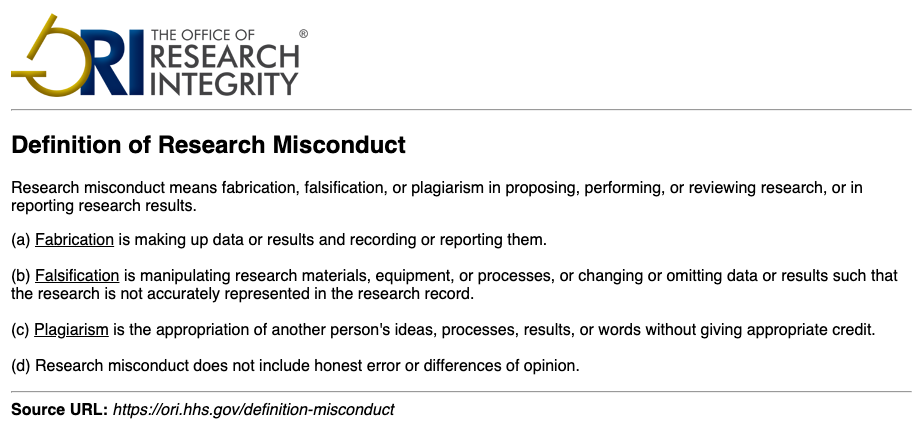
In Part 1 and Part 2 of this series, I showed some examples of plagiarism and falsification in scientific papers, which the Office of Research Integrity (ORI) considers two of the three forms of Research Misconduct. Here, we will look at the third type of misconduct, fabrication. ORI defines fabrication as follows:

Fabrication is making up data or results and recording or reporting them.”

Office of Research Integrity: Definition of Research Misconduct
Continue reading “What is Research Misconduct? Part 3: Fabrication”

What is Research Misconduct? Part 2: Falsification

This is Part 2 of a series of 3, which also includes Part 1: Plagiarism, and Part 3: Fabrication.

In Part 1 of this series, I showed some examples of plagiarism in scientific papers, which the Office of Research Integrity (ORI) considers one of the three forms of Research Misconduct. Here, we will look at the second type of misconduct, falsification. ORI defines falsification as follows:

Falsification is manipulating research materials, equipment, or processes, or changing or omitting data or results such that the research is not accurately represented in the research record.”

Office of Research Integrity: Definition of Research Misconduct
Continue reading “What is Research Misconduct? Part 2: Falsification”

What is Research Misconduct? Part 1: Plagiarism

This is Part 1 of a series of 3, which also includes Part 2: Falsification, and Part 3: Fabrication.

The Office of Research Integrity (ORI), part of the USA Department of Health and Human Services, defines Research Misconduct on their website:

Let’s clarify that a bit more with some examples. In this blog post, I will discuss plagiarism.

Continue reading “What is Research Misconduct? Part 1: Plagiarism”

The Space Dentist

This blog post is not intended to be an allegation of misconduct. I am just wondering about some unclarities and unexpected similarities in a set of papers. It is about studies showing the effect of space travel by putting volunteers on a tilted bed – or sending volunteers to the Utah desert.

Continue reading “The Space Dentist”

Depressed rats

A blog post about a cruel, seemingly unnecessary animal model. Compiled from a Twitter thread I did on May 17, 2019. Intended to make you feel uncomfortable. I am so sorry.

Continue reading “Depressed rats”

It’s written in the scars

A post illustrating how some companies choose to publish in low-impact journals that do not appear to apply rigorous peer review. The general audience cannot easily distinguish properly peer-reviewed papers from those that are accepted without much scrutiny. A paper that appears in one of these “easy” journals will not be seen by a large scientific audience, but can be used by a company to show that their product has been “peer reviewed”. This blog post is not intended to be an allegation of misconduct.

Continue reading “It’s written in the scars”