A quick post after stumbling upon a paper that got retracted years ago, but the publisher isn’t going to tell you. Springer still charges $40 (plus tax) to read the retracted paper itself — then will happily charge you another $40 for selling you the retraction notice.
Continue reading “Springer and the Double Dip”
Similar images from the Technion
The Technion-Israel Institute of Technology is the oldest university in Israel, ranking itself ‘among the world’s top science and technology research universities’.
It is here that a group of researchers appears to have been publishing remarkably similar photos for the last decade — or more.

Share this:

Newly appointed Boğaziçi University rector accused of plagiarism
Students and faculty of Boğaziçi University, a top university in Istanbul, Turkey, protested this week after the appointment of Melih Bulu as its new president (news coverage in English in The Guardian, The Times, and Bloomberg).
Bulu’s appointment was criticized as being more political than academic, because he is a close ally of Turkish President Erdogan. Critics also accused him of plagiarism in his published articles and PhD thesis. Bulu has a PhD in business management. During this week’s protests, his 2003 thesis suddenly disappeared from a Turkish repository site.
Here, I take a closer look at Bulu’s thesis to see if these accusations hold water.

Share this:

2020: A year in review
Still a couple more hours for the year 2020 to end. A year in which so much was lost — our freedom to go where we like and meet whom we want, jobs, health, and the lives of too many friends and family members.
I feel that science has lost something as well — credibility with the general public because of the back and forth on some issues regarding COVID-19 prevention and treatment. It is hard to explain to non-scientists how difficult and slow science sometimes is, especially in light of a new virus, a new pandemic. Good science is often slow, but we all wanted fast answers, and this brought a lot of “Yes we found it!” and “Oh, well, never mind” papers that were confusing to understand or explain. In addition, the current US government has not been very science friendly, encouraging false statements to confuse many of us.
Still, there are some hopeful signs. The first coronavirus-vaccines are being distributed and a new US government will hopefully restore some of the faith in science that has been lost in the past years.
Here, I look back on the work in science integrity that I did in the past year. All the work I list here was unpaid, and I thank my loyal Patreon subscribers for their ongoing support that allows me to keep on doing my volunteer work.
Continue reading “2020: A year in review”Share this:

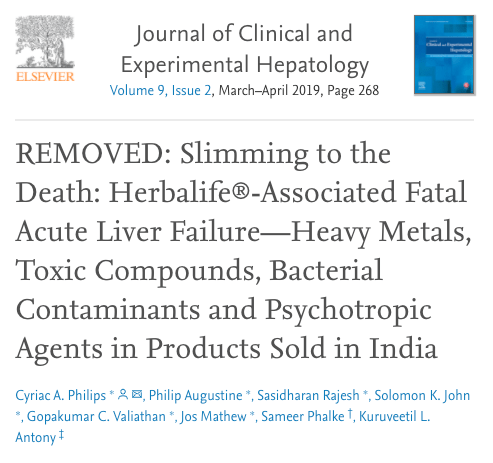
Paper about Herbalife®-related patient death removed after company threatens to sue the journal
A paper describing the death of a young woman trying to lose weight by consuming Herbalife® products has been withdrawn after the company threatened to sue the journal.
Share this:

Forty five papers from Tianjin Medical University
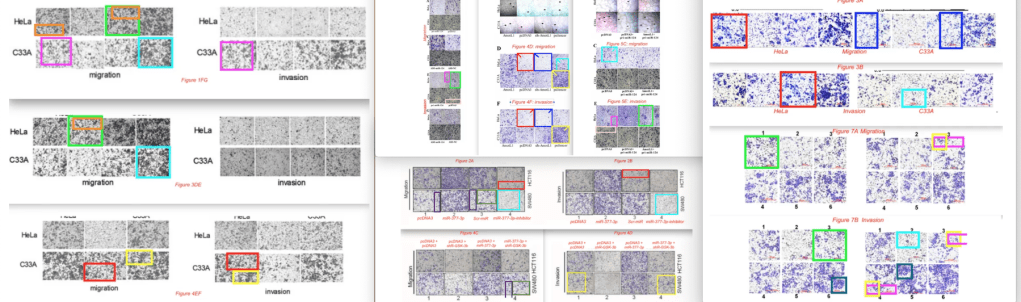
This week I worked on a large set of papers from a research group at the Tianjin Life Science Research Center at Tianjin Medical University. The group, headed by Dr. Hua Tang and funded by many National Natural Science Foundation of China grants, has published a total of 113 PubMed-indexed papers.
However, a significant number of these — 45 as of today — have PubPeer posts in which concerns are raised about their figures.
Share this:

Frontiers in Immunology wins fourth “This Image Is Fine” Award
Two flow cytometry panels in a 2018 Frontiers in Immunology paper by authors from Sweden and China appeared to share some data points. The image duplications were very suggestive of post-experiment image alteration. Yet the editors accepted the authors’ excuse that it was an “accidental error”, and published a correction. For this, they will be awarded the fourth “This Image Is Fine” Award.
Continue reading “Frontiers in Immunology wins fourth “This Image Is Fine” Award”Share this:

Science paper from Dutch top-institute retracted
A 2007 paper published in Science — in which I found image irregularities back in 2015 — has finally been retracted. For five long years, the journal took no action. But after I tweeted about the case, it eventually acted.
Continue reading “Science paper from Dutch top-institute retracted”Share this:

Troubles with VSELs
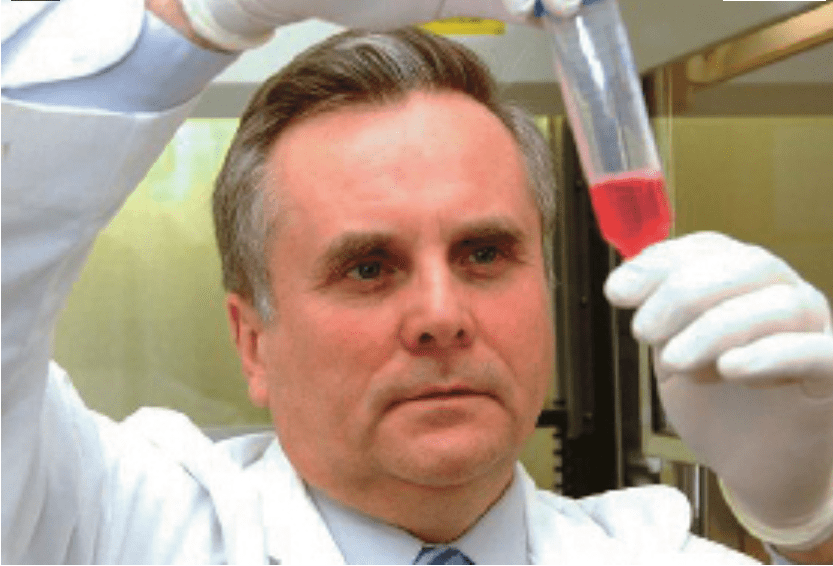
A stem cell research group at the University of Louisville, Kentucky — famous for apparently discovering an exciting new class of stem cells — could be facing new troubles.
Although the work of Mariusz Ratajczak was supported through large NIH and Vatican grants, no other lab could replicate his findings on very small embryonic-like stem cells (VSELs).
And now, 28 papers from the Ratajczak lab are listed on PubPeer for image duplication and textual similarity concerns.
March 2022 update: No misconduct found
The University of Louisville sent their final decision – dated July 29, 2021 – to me today – March 23, 2022 (shared here with permission).
“The University of Louisville found there was no research misconduct. The institution followed its established, thorough, and robust process and made no findings of research misconduct against Dr. Ratajczak associated with any of the allegations, including all the allegations that continue to persist publicly on the internet. ”
Continue reading “Troubles with VSELs”Share this:

Researcher photoshops his name onto a Nature Communications paper
Here’s a novel way to boost your resume: photoshop your own name onto a paper written by another research group. Then pin it to your Twitter profile and claim it as your own paper.


