This blog post is based on a Twitter thread I did on March 27, 2020, after seeing Mathieu Rebeaud’s Tweet about a new white paper from the institute of Didier Raoult. That not-yet peer reviewed paper describes a group of 80 COVID-19 patients, all treated with a combination of hydroxychloroquine and azithromycin. This treatment had shown some promising results in a very small, not well-executed study by the same group. Unfortunately, this second study does not have a control group and the patients did not appear to be very sick. So here is my critical review.
Continue reading “An observational study without a control group”
Post-publication reviews on COVID-19 papers
We are in the midst of a viral pandemic with huge effects on human health, social interactions, and the economy. Suddenly, lots of people have opinions or claim to have solutions to solve the COVID-19 situation. Not surprisingly, the Coronavirus epidemic has led to an enormous input of scientific papers, editorials, letters, reviews, trials, and what have you not. Most of these have been written hastily, without the rigor and thoughtfulness and editing that are normally essential to scientific publishing. Some of these papers are great, many of them not so much. Social media is exploding with all kinds of post-publication reviews of heavily discussed scientific papers. This post is an attempt to collect critical reviews of some of these COVID-19 related scientific papers.
Continue reading “Post-publication reviews on COVID-19 papers”Share this:

Thoughts on the Gautret et al. paper about Hydroxychloroquine and Azithromycin treatment of COVID-19 infections
There has been a lot of excitement – and even a presidential tweet about a recent paper from the lab of Didier Raoult, an infectious disease specialist in Marseille, France. But although this study might offer a glimmer of hope, there are some serious problems with the paper too.
Continue reading “Thoughts on the Gautret et al. paper about Hydroxychloroquine and Azithromycin treatment of COVID-19 infections”Share this:

Dr. Ai Fen, 艾芬, the Wuhan Whistle
Dr. 艾芬 (Ai Fen) has played a key role in ringing the alarm in the 2020 COVID-19 outbreak. But blog posts about Dr. Ai Fen ‘s role in the COVID-19 outbreak have been mysteriously disappearing. This post is my contribution to make sure that the Internet Never Forgets.
Continue reading “Dr. Ai Fen, 艾芬, the Wuhan Whistle”Share this:

Update on the COVID-19 TCM paper
Some new developments on the COVID-19 TCM paper that I wrote about yesterday. The patient case and their CT scan image appear to have been copied from another paper by another group.
Continue reading “Update on the COVID-19 TCM paper”Share this:

Some critical notes on a COVID-19 TCM paper
The recent COVID-19 outbreak has led to an enormous amount of preprints and rapidly-approved papers of variable quality. A recently published paper in Pharmacological Research called “Traditional Chinese Medicine for COVID-19 Treatment” caught my eye. The title suggested that Traditional Chinese Medicine (TCM) could be used to treat patients that had fallen ill with the viral disease, but a quick read showed that the paper promised much more than it delivered. Here is a critical review.
Continue reading “Some critical notes on a COVID-19 TCM paper”Share this:

Western blots
Many image problems (duplications, manipulations) in scientific papers are found within Western blots. Several readers have asked me to explain what Western blots are, so here is a blog post written with the amazing help of Jon Cousins to provide some insights.
Continue reading “Western blots”Share this:

The Tadpole Paper Mill

Most posts on this website are about duplications within or between figures in the same paper, or about duplications found between papers by the same group of authors. But now, our small group of image forensics detectives has come across a large set of papers – over 400 as of today – from different authors and affiliations that all appear to have been generated by the same source. Based on the resemblance of the Western blot bands to tadpoles (the larval stage of an amphibian, such as a frog or a toad), we will call this the Tadpole Paper Mill.
Update: for those who cannot access the Google Sheets link above, here is a PDF version embedded in WordPress which I hope will work for all (generated March 3, 2020):
Continue reading “The Tadpole Paper Mill”Share this:

No Manipulation Was Detected in This Image
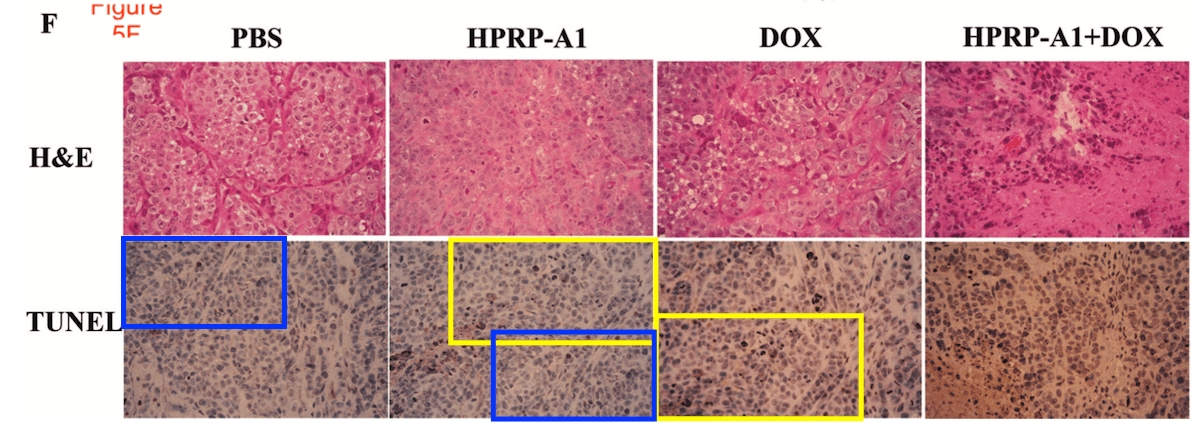
This post is not an accusation of misconduct.
In a previous post, I wrote about the high percentage of image concerns in papers published in Oncotarget, an Open Access journal. PubPeer, the post-publication peer review website contains many posts about Oncotarget papers flagged by me and other image duplication detectives.
Instead of reflecting on these concerns and improving their peer review and quality control process, Oncotarget apparently has decided to try to prove that these concerns are not real.
Continue reading “No Manipulation Was Detected in This Image”Share this:

Oops!… I Did It Again. When to correct or retract?
How many image duplications in a paper would be acceptable? If the paper has two identical photos that represent different experiments, and the authors’ reply is: ‘Oops, we uploaded the wrong photo’, that would be acceptable. Mistakes happen, and the authors can correct the error by sending in an erratum with the correct photo(s). But should editors be equally forgiving in the case of two cases of “Oops, we made a mistake”, or other, more complicated scenarios?
Continue reading “Oops!… I Did It Again. When to correct or retract?”

