On Twitter, @DrVanDamme pointed me to a paper in published in July 2019 in the International Journal of Oral and Maxillofacial Surgery, a journal of the International Association of Oral and Maxillofacial Surgeons (IAOMS).

A blog about science integrity, by Elisabeth Bik, for Harbers-Bik LLC. Support my work at Patreon.com/elisabethbik
On Twitter, @DrVanDamme pointed me to a paper in published in July 2019 in the International Journal of Oral and Maxillofacial Surgery, a journal of the International Association of Oral and Maxillofacial Surgeons (IAOMS).
A quick post about a story I have been reading this morning. The Wisconsin State Journal reported last week about a graduate student who committed suicide after spending seven years working for an abusive Engineering professor at UW-Madison.
The article does not mention scientific misconduct, but it gives a glimpse behind the scenes of the toxic environments that some principal investigators (PIs) create. Something that is very much related to science misconduct, because extreme pressure by a professor might be one of the reasons that scientific studies might include fabricated or falsified data.
Continue reading “A sad story about a toxic lab”Several readers have asked about plagiarism detection. So in today’s post I will talk about the tools I have been using, and some other tools that are available.
Continue reading “Plagiarism detection tools”While I was in Scotland last month to give a talk, I had the pleasure to meet with the wonderful Gemma Milne. She is a Science and Technology Journalist and founder of Science: Disrupt.
She has the gift to turn lovely breakfast chatter about science misconduct into beautiful written words. Here are two recent articles Gemma wrote about the work that we science “sleuths” are doing.
Continue reading “Gemma Milne writes about science integrity work”This blog post expresses my personal opinion. It is not an accusation of misconduct.
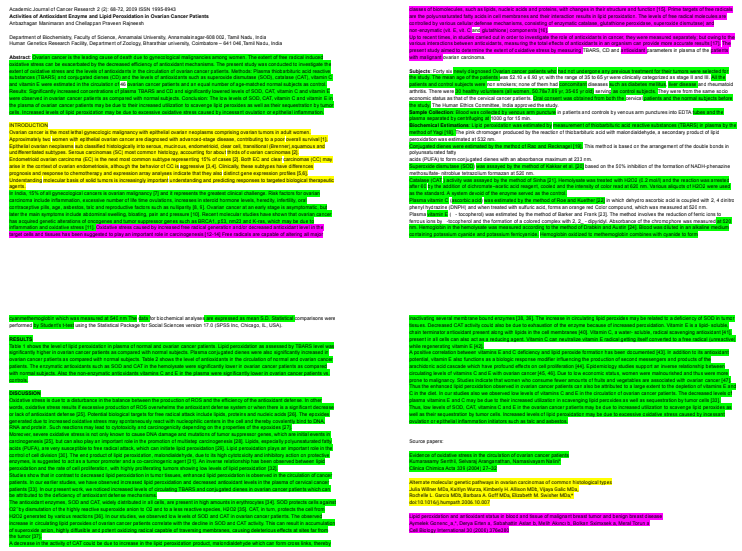
In my last post, I wrote about a large set of around 200 problematic papers, all from research groups at Annamalai University in Tamil Nadu, India.
There are two additional problem sets.
Continue reading “More troubles at Annamalai University”This blog post expresses my personal opinion. It is not an accusation of misconduct.
Update October 2020: The list of Annamalai University papers with concerns has grown to 229. Here is the list, with links to the PubPeer posts, as an Excel file and as a PDF.
Annamalai (often spelled “Annaamalai”) is the name of an Indian hit-movie from 1992. It is also the name of a state university in Tamil Nadu, a state in the South of India.

Annamalai University was founded in 1929 (celebrating its 90th Anniversary this year) by Rajah Sir S. R. M. Annamalai Chettiar, and is ranked in 801-1000 in the world by The Times Higher Education.
Continue reading “Concerns about papers from Annamalai University”This blog post expresses my personal opinion and is not an accusation of misconduct.
The STAT (“signal transducer and activator of transcription“) protein family consists of proteins involved in many important aspects of cellular function, such as growth, differentiation, and apoptosis (programmed cell death). These transcription activators are activated themselves if other molecules bind to them, and they act as messengers that transfer changes outside of a cell to inside the nucleus, by binding to promoters and determining which genes are switched on or off. One of STAT proteins, STAT3, in particular has been the topic of many studies, because it might play a role in cancer. Simply put, the continuous activation of STAT3 might induce cancer, and STAT3 might be a target for new anti-cancer drugs.
A recent study, published on 28 August 2019 in Nature by authors from Harvard Medical School and the Dana Farber Cancer Institute, therefore gained quite some attention. It reported on one of the ways by which STAT3 can be activated, through the binding of fatty acids in a process called palmitoylation.
Continue reading “Fatty acids, STAT3, and unexpected image similarities”A reader pointed out a 2016 paper published in Dermatologic Surgery.
Daily Use of a Facial Broad Spectrum Sunscreen Over One-Year Significantly Improves Clinical Evaluation of Photoaging – M. Randhawa et al. – Dermatologic Surgery: December 2016 – doi: 10.1097/DSS.0000000000000879

One of my recent investigations led me to expand my set of figure types to look at. For our 2016 mBio study, in which I scanned >20,000 papers for image duplication, I focused on real photos of Western blots, agarose gels, tissue sections, etc.
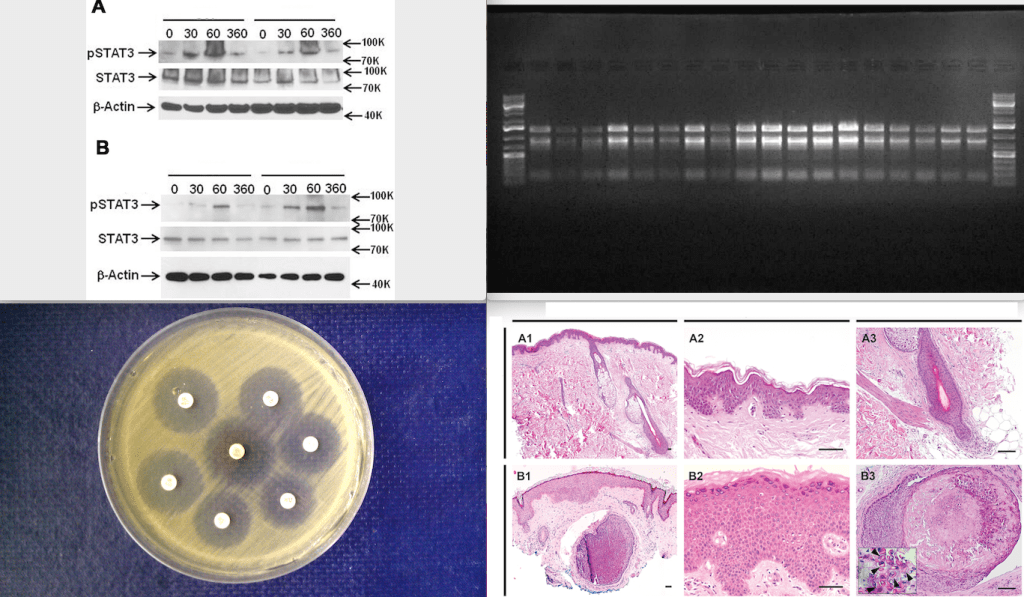

A short post based on a Twitter thread I wrote today about a paper I had seen a while ago. You can also read the ThreadReaderApp post, which many people find easier to read.
A couple of weesk ago, I saw a social media post claiming that the HPV vaccine would cause infertility in women, based on results in a peer-reviewed paper. It sounded hard to believe, because many other studies have found that the HPV vaccine is safe to use. There was no time that day to look up the details and I let it go.
Continue reading “Concerns about a paper on HPV vaccination and pregnancy rates”



 Science Integrity Digest