Yesterday, October 30, 2023, Scientific Reports retracted two papers from the group of Didier Raoult. Both papers described studies in which stool samples were taken from malnourished children in African countries, and both were retracted because of the lack of ethical approval from these countries to obtain samples.
Hindawi — and its parent company, Wiley — have recently announced that they will retract hundreds of papers from journals targeted by paper mills. The papers were all published in ‘special issues’, with the guest editors being either asleep at the wheel or perhaps knowingly looking the other way.
In this blog post, I will take an in-depth look at some of these papers.
As I was doing a reverse-image search online on a set of papers, I saw an unrelated photo of a skin biopsy that appeared to contain repetitive areas. Even in the small Google Image Search thumbnail it was clear to me that something unexpected was going on in this image.
The discovery led me to a set of 12 papers from a research group at the Hematopathology Department of the Texas MD Anderson Cancer Center, all with histopathology photos showing unexpected repetitive structures.
Source: Diverse landscape of dermatologic toxicities from small‐molecule inhibitor cancer therapy, DOI 10.1111/cup.14145. Can you spot the repetitive patterns?
This post describes a set of over 20 papers with mostly image problems from the Department of Pharmacology at the School of Medicine of Zhejiang University in Hangzhou, China. All papers have Professor Ximei Wu as the common – and often corresponding – author. The Wu lab conducts research on stem cell and bone development, and their papers contain many images of Western blots and immunohistochemistry experiments.
Previously I wrote about the Tadpole Paper Mill and the Stockphoto Paper Mill papers. Paper Mills are companies that sell fake or plagiarized scientific papers to authors who need them for their career. Certain countries have strict requirements or monetary incentives for medical doctors, graduate students, or other researchers to publish papers. In such countries, other researchers or business folks have found creative ways of making money by selling fake papers to researchers. Such paper mills are similar to essay mills where ghostwriters offer their services to undergraduate students.
Countless hours have been put into finding such linked sets of papers by volunteers such as Smut Clyde, Tiger, Jennifer Byrne, Jana Christopher, and Anna Abalkina. Here, we will look at a slightly different paper mill.
Citations lend credibility to a scientific paper. And sometimes even result in a cash bonus. But while most researchers just hope their paper will be cited by others, some authors have found more ‘creative’ ways of getting their papers noticed. A recent comment on PubPeer offers a glimpse behind the scenes.
In November 2020 I wrote about a set of 28 papers published by Mariusz Ratajczak, a professor at the University of Louisville who works on VSELs, very small embryonic-like stem cells.
Most of these papers included reused images, presented as new experiments without proper citation, while some others appeared to show overlapping photos or duplicated elements within the same photo. You can read my 2020 blog post here.
I shared my concerns about these papers with the university in February 2019.
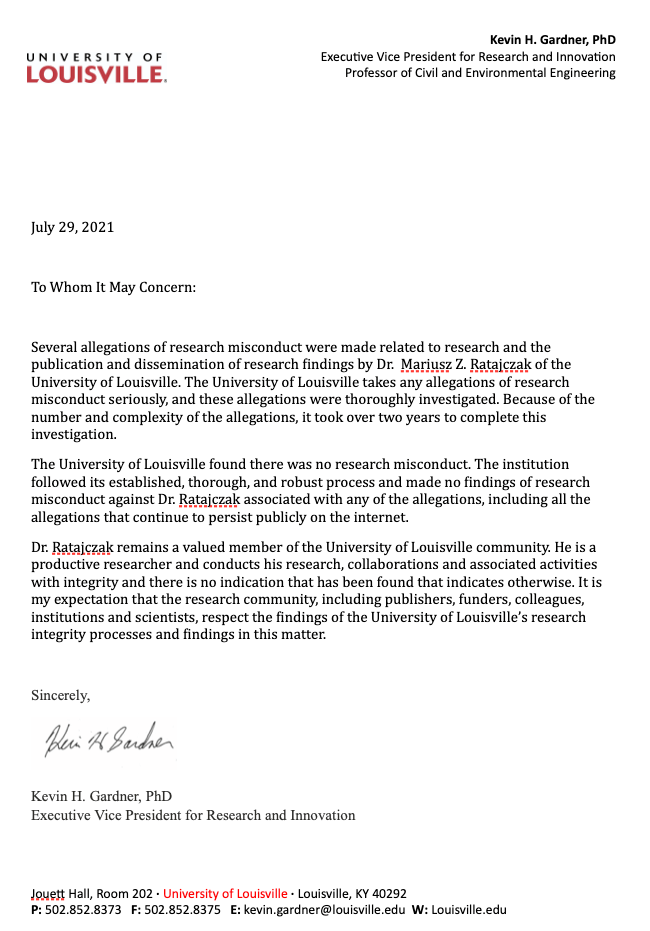
Today -March 23, 2022 – the University of Louisville sent their final decision to me, and I am sharing this here with their permission.
“The University of Louisville found there was no research misconduct. The institution followed its established, thorough, and robust process and made no findings of research misconduct against Dr. Ratajczak associated with any of the allegations, including all the allegations that continue to persist publicly on the internet. ”
In October 2020 and 2021 I reported a total of 21 papers published by Professor Vojtěch Adam that contained image problems. Vojtěch Adam is a professor in chemistry, and head of the Department of Chemistry and Biochemistry, at Mendel University in Brno, Czech Republic. He is a top Czech researcher in cancer and nanotechnology.
Today, a day before his appointment as the new Rector (Dean) of Mendel University, a committee released a report of their findings from an investigation into twelve of these papers. Their conclusions came as a big surprise.
This is Part 3 of a series describing papers from the Institut Hospitalo-Universitaire Méditerranée-Infection (IHUMI or IHU) and Aix-Marseille Université (AMU) — institutions in Marseille, France — with potential problems.
In Part 1, I listed papers with image concerns. In Part 2, I focused on a set of papers describing many different research projects on specimens collected from homeless people — but all run under the same IRB approval number.
In this post, we’ll take a look at IHU/AMU papers describing samples obtained from people in African countries. Many of them lack wording on ethical approval by the local authorities, and all lack authors from these countries. This type of research might fall under the definition of neo-colonial science.
Tall el-Hammam was a Bronze-Age city in current Jordan that is a site of archaeological interest. It is believed by some to be the biblical city of Sodom. According to the Bible, Sodom and Gomorrah were cities full of sinners, which were destroyed by “sulfur and fire” sent by God.
A paper published last week in Scientific Reports now claims that Tall el-Hammam was destroyed by a “cosmic airburst”, perhaps by the impact of a meteorite or comet. The article provides evidence of melted pottery and plaster, shocked quartz, and diamond-like carbon, all suggesting the city was exposed to a sudden high-temperature event.
The paper got a lot of media attention. However, several images presented in the paper appear to contain repetitive elements, suggestive of cloning.






 Science Integrity Digest